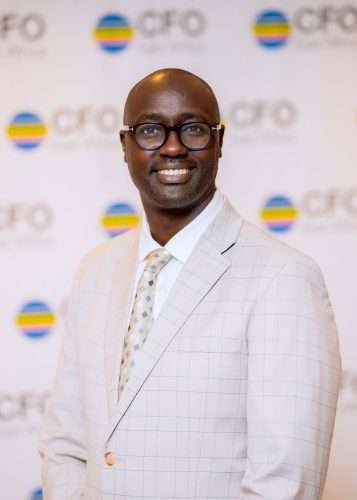
Following MTN Uganda's landmark secondary market listing in 2024, Andrew Bugembe took home multiple awards at the 2025 CFO Awards for East Africa.
The CFO of the Year for Uganda and Finance Transformation Award winner reflects on the discipline that drove those achievements and his strategy for 2026.
You led MTN Uganda through its first IPO and a highly successful secondary market return. Which moment of that journey stands out most for you?
Guiding MTN Uganda through its IPO was challenging and required significant effort, but one vivid memory remains. On the day trading began, seeing the first price set on the secondary market made everything real before that, it was all about valuations, educating investors, holding roadshows, obtaining regulatory approval, and preparing internally.
The return on the secondary market that was oversubscribed was icing on the cake, when shares started trading successfully, it served as an independent, real-time affirmation of the team's years of hard work. What made it even more special was the widespread participation: this IPO was a milestone for Uganda's capital markets, welcoming tens of thousands of retail investors for the first time. Watching everyday Ugandans become shareholders in a company they use regularly and witnessing their faith rewarded by the positive performance of the shares was deeply gratifying.
How does it feel to be recognised for your efforts?
It's deeply humbling, more than anything else. Recognition is gratifying, of course, but what it really represents is acknowledgement of a team led effort and a long period of sustained discipline. It's over 5 years since I returned to Uganda and these external recognitions are a reaffirmation of the great work achieved so far because of strong teams, supportive boards, committed shareholders, regulators who engage constructively, and advisors who push you to higher standards.
On a personal level, it's affirming because finance leadership can often be invisible when things go well. You spend years focused on risk, controls, governance, and execution, hoping the outcome speaks for itself. When that work is recognised, it tells you that the values you prioritised integrity, preparation, transparency, and long-term thinking mattered. Perhaps most importantly, it creates a sense of responsibility. Recognition raises the bar. It reminds you that people are watching how you lead next, how you mentor others, and how you use that platform to build stronger institutions and markets going forward.
The IPO oversubscription was a clear vote of confidence. What governance or transformation decision do you think made the biggest difference?
If I had to single out one choice that had the greatest impact, it would be our early and clear commitment to upholding public-company standards of governance and transparency long before regulations demanded it. We intentionally chose to act as though we were already listed: we improved board independence, tightened financial controls, upgraded reporting standards, and insisted on thorough disclosure and risk management. Although this approach was sometimes challenging because it brought problems to light sooner and required tough internal discussions, it ultimately established genuine credibility.
Just as significant was the way we changed our interactions with stakeholders. Regulators, local investors, and the wider community were regarded as long-term partners rather than just transactional contacts. Our investor education programme was essentially a governance initiative that showed respect for shareholders and demonstrated trust in the business beyond the details of the offering. When the IPO finally happened, investors weren't being sold only on future discipline; they could already observe it in practice. The high demand for shares reflected the trust we'd built. Markets generally reward companies whose actions consistently match their words.
As the Finance Transformation Award winner, which technology or capability do you think will reshape telco finance the most in 2026?
By 2026, telco finance will be transformed by AI-powered real-time processes that combine automation, analytics, and predictive intelligence. Traditionally focused on historical data, finance teams are now leveraging near-real-time insights to improve revenue assurance, capex optimisation, working capital, and customer profitability. Key drivers include intelligent automation.
Beyond routine tasks, AI is automating complex processes like revenue leakage detection and credit risk scoring. Finance can now forecast lifetime value, ROI, and pricing scenarios, shifting from record-keepers to strategic partners. Success hinges on finance owning data quality and governance, treating information as a valuable asset. Effective CFOs will move from reporting the past to anticipating needs, enabling smarter decisions and stronger performance amid market volatility.
You've had a big awards year. How does this recognition influence how you plan for the next phase of MTN Uganda's finance strategy?
As MTN Uganda moves forward with its finance strategy, the focus is on advancing three main priorities instead of dwelling on past successes. First, making the finance function future ready. We are committed to ongoing investment in skills, systems, and data capabilities so that finance leads business progress rather than merely keeping up. This includes expanding analytics, increasing automation, and developing talent capable of blending financial accuracy with strategic vision.
Secondly, improving accountability in capital allocation. As a publicly listed company, every unit of capital must justify its use. Recognition comes with increased expectations for transparency and discipline in returns, prompting us to strengthen portfolio management, prioritise capital expenditures, and closely monitor value after investments are made.
Thirdly, building institutions beyond MTN Uganda itself. Recognition provides a platform that brings both opportunity and responsibility to encourage better market practices, mentor future finance leaders, and support the growth of Uganda's capital markets. This outward perspective is now embedded as a core part of our strategy, not an afterthought.
What is one goal you have set for yourself or your team as you enter 2026?
As we approach 2026, my primary objective is to further transform the finance function from simply reporting on performance to actively influencing it. This involves integrating finance earlier and more thoroughly into strategic and operational decisions whether it's network investment, product development, pricing, risk management, or capital structure. True success will be reflected not just in accurate reporting and robust controls, but in how frequently finance insights drive different outcomes for the business.
For the team, the focus is on building capabilities: developing finance professionals who are skilled with data, adaptable in uncertain situations, and respected as business partners. Achieving this means ongoing skills development, defining value-driven accountability, and fostering a culture that encourages curiosity and constructive questioning. We'll know we've truly advanced if, by the end of 2026, finance regularly helps shape better decisions rather than just explaining them after they've been made.