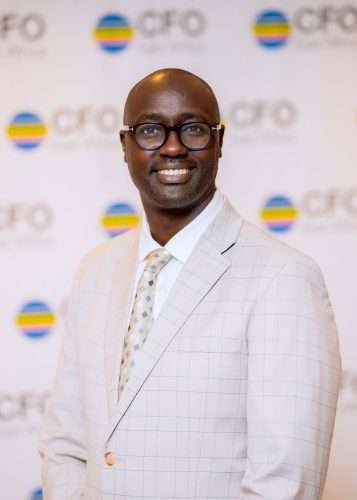
CCPL head of finance Pius Ngira breaks the standard accountant mould, combining grit and curiosity to keep cash flowing smoothly. He believes modern finance leaders must step onto the factory floor and use smart tools to make faster, bolder business moves
CCPL head of finance Pius Ngira believes the first responsibility of a finance leader is to understand the business deeply. At Coast Concrete Poles (CCPL), that means understanding how engineering, raw materials, production and stock management affect the numbers. It is a practical approach guided by the demands of manufacturing. Here, small differences in how materials are purchased and consumed affect the accuracy of financial information.
“If you don't understand the business, you cannot tell whether financial resources are fully utilised or underutilised, and won’t know how to handle those situations. In manufacturing, cost of goods sold or direct cost is driven heavily by engineering,” he continues. “As a finance leader, I must understand the production formulas and conversion ratios, for example, buying raw material in tonnes versus usage in kilograms, so we can manage stock, verify consumption and prevent discrepancies.”
His role requires him to work across several parts of the organisation. His team includes procurement, accounts payable, accounts receivable, tax and budgeting. The structure gives him a view of the company from purchasing and production through to collections and compliance.
He says, “On Mondays, I meet with the budget, compliance, and tax teams to review upcoming deadlines and bank facility maturities. On Tuesdays, team members submit their weekly activity plans. For accounts payable, they share what they plan to pay. For accounts receivable, 80 percent of our business is with electricity utilities through government entities and telecommunications companies for fibre infrastructure. Receivables sometimes take long time to settle, so we track receivables closely to notice any gap in working capital and figure out how to finance those gaps through bank facilities like invoice discounts for the business to run smoothly.”
Seeing different businesses differently
That broad view of finance was developed through experience across different types of organisations. Pius began his career in a non-profit, where his work largely focused on proposals and budgets for grants. He later moved into a profit-making organisation working at a microfinance institution and eventually working at the company’s group level. Each setting required him to adjust his understanding of how financial information is generated and used.
He notes, “Yes, it was my target to go into a profit-making organisation. In non-profits, you only get about 50 percent of the full accounting experience. In a commercial enterprise, you have to know the cash burn rate, manage receivables, handle supplier payments and utilise banking facilities. In non-profits, you don't use credit lines, bank guarantees, or loans. In commercial finance, your knowledge comes into play – managing liquidity, using invoice discounting when cash is tight or placing fixed deposits to retain cash value when liquidity is high.”
Working at the group level added another layer to that experience. He had to switch between businesses with different revenue structures and financial needs. The experience strengthened his ability to move between businesses without losing sight of the underlying principles.
“Under IFRS, we have general trading companies and specialised industries. When working at the group level as chief accountant, producing financial statements requires distinct approaches. For example, microfinance falls under a specialised industry where revenue begins with interest income, followed by interest expense on borrowed funds to arrive at net interest income. Trading and manufacturing start with revenue minus cost of sales to get gross profit. Managing multiple subsidiaries simultaneously required a constant mindset shift between microfinance, manufacturing, catering, and real estate,” he explains.
Growing self and others
Pius brings the same emphasis on understanding and learning to his approach to leadership. He gives members of his team opportunities to face challenges directly rather than keeping responsibility concentrated at the top.
“To bring out the best in my team, I give them challenges. For example, section heads now attend audit entry and exit meetings directly so they understand findings firsthand,” he says.
His approach to learning came early in his career. His boss at the NGO where he worked was an important influence. The advice he gave Pius has become part of how he views professional development.
“In 2021, my immediate boss, a finance director at the NGO, told me when I signed my contract, 'Make sure you feed your mind with new knowledge from time to time. That is how you stay young.' He explained that while physical exercise keeps the body fit and young, reading and feeding your mind with new inputs keeps you mentally sharp and adaptable. That advice deeply shaped my approach to continuous learning,” he recalls.
Beyond the spreadsheet
Strategic thinking also extends to the environmental effects of business decisions for Pius. He believes environmental responsibility requires examining what happens throughout the supply chain.
He explains, “While shifting to concrete poles saves trees, we also have to examine the wider supply chain such as using wooden spacers between stacked concrete poles during transport or managing carbon emissions from delivery trucks. So, a product could be classified as environmentally friendly, but its movement from production to consumption might have affected the environment. It requires looking at environmental impacts holistically from production to end consumer.”
His interest in the analytical side of finance is evident even outside the demands of his job. He enjoys building financial models and testing hypothetical scenarios. He is curious about how financial decisions might work in practice.
“I am genuinely happy living in the finance and accounting environment. I enjoy generating models and analysing financial scenarios. So, building financial models on my laptop such as modelling a hypothetical merger and acquisition between CRDB Bank and NMB Bank just to see what the numbers look like,” he says.
Away from finance, Pius has interests that reveal a different side of his personality. He has ambitions that are completely different from finance. He has looked at learning two new skills.
He says, “My dream outside finance is to learn how to DJ and I’ve always wanted to drive long-distance heavy trucks. It’s likely because I've played video games like Euro Truck Simulator. But I picked up the application form from the National Institute of Transportation to learn heavy truck driving and I’ve chatted with a DJ on Instagram who has a DJ school, asking for the course structure.