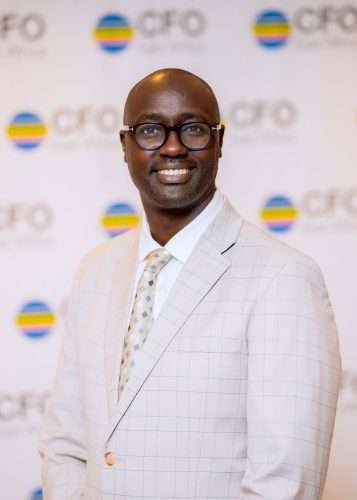
At the second annual CFO East Africa Summit in Kigali, a closing panel brought together three finance leaders to reflect on the moments that have shaped how they lead. Ntiranyibagirwa Ange, group head of finance at BK Group, Dan Mugisha, CFO of Africa Improved Foods, and Collins Otieno, head of finance at Ampersand Energy, revealed the lessons that have stayed with them and the thinking that continues to guide their work.
Ange opened by tracing his path into finance to an unexpected moment during his studies. He had been on course to become a teacher, following in his parents' footsteps, when a chance encounter changed direction entirely. An announcement about a three-month cashier vacancy caught his eye in a classroom of around three hundred students. While everyone else looked away, he saw it as the opening he had been waiting for.
"I had the vision of where I wanted to be. When I saw it, because I had the vision of where I wanted to be, I went there for three months. The cashier took leave. After three months, I became the finance manager. That is when my career started," he said.
The position was at the company that would become his long-term employer. But Ange's most hard-earned lesson came later, when an excess of trust led to consequences he had not anticipated. In a previous role, he had delegated extensively and relied heavily on a colleague, only for a fraud to occur that might have been prevented had he stayed closer to the detail.
"You can delegate, you can trust, but don't lose control. I had a case whereby you over-trust someone. You give him everything. And then suddenly, boom, there is a fraud. It was a bad thing, but later on, as I continued my career, it served as a reason to prevent further fraud from happening," he said.
The experience sharpened his instincts. When a similar pattern emerged three months into a role at his current organisation, he was able to catch it early because he recognised what he was seeing.

A helicopter view
Dan Mugisha drew on an image that had surfaced during the group discussions earlier in the evening. A fellow CFO had described the danger of getting lost in the details of the dancefloor, and the clarity that comes from stepping back to see things from the balcony.
"As a CFO, when you get lost in the middle of the details, a lot of accounting, you are not able to pull out and have that helicopter view, to look at things through different lenses. You have to be very careful. You cannot multitask. If you are on the dancefloor, you are on the dancefloor. If you are on the balcony, you are on the balcony," he said.
He also returned to a principle he considers non-negotiable. Regardless of how the tools of finance evolve or how much the strategic demands of the role expand, integrity remains the one thing a finance leader cannot afford to trade away.
"Integrity has to be key. When I say that, I mean you are trying to avoid being a double-language person. You say A, but you mean B, and that will discredit you. With integrity, you build trust with your team, with the bosses, with all your stakeholders basically," he said.

Heads in the clouds, feet on the ground
Collins Otieno closed the panel with a framework he has come to rely on. Effective finance leadership, in his view, requires three things held in balance simultaneously: the strategic imagination to think beyond the immediate, the connection to purpose that keeps the work meaningful, and the practical grounding that turns ideas into results.
He urged CFOs to resist the pull towards any one of those at the expense of the others, arguing that the leaders who remain most valuable are the ones who can move fluidly between all three. As he sees it, the CFO who can hold strategic vision and operational discipline together is the one best placed to lead as the demands of the role continue to evolve.
"Keep your head in the clouds to think strategically, the business in your heart to stay connected to purpose, and your feet firmly on the ground to remain practical. But you also have to have a strong bias for action, because ultimately it is execution that turns insight into impact," he said.