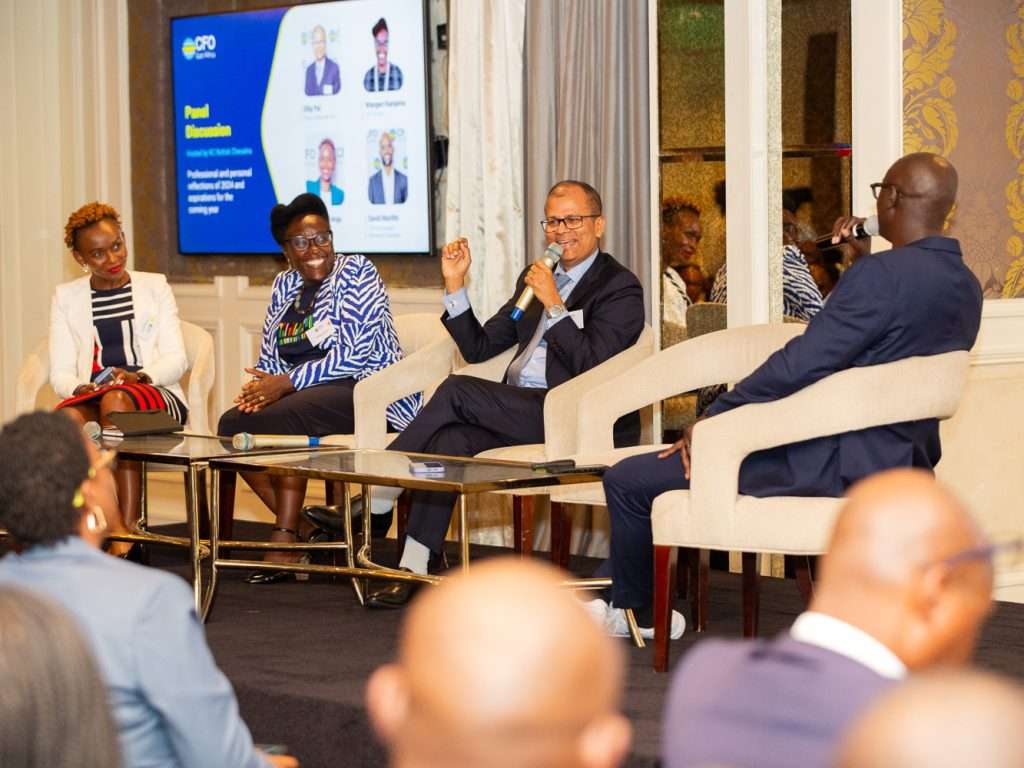
Safaricom CFO Dilip Pal, Spiro group CFO Wangeci Kanjama, and ZEP-RE CFO Rachael Gitonga spoke candidly about their triumphs and losses in 2024 and shared their hopes for the new year, during a panel discussion at the 2024 CFO East Africa Year End Summit.
Dilip recalled that when he visited Kenya for the first time in 2017, he and his family spent part of their 10-day trip at the Maasai Mara, ticking off a bucket list item. Later in 2020, he received a call about his current role. At the time, he and his wife were in Bangkok, Thailand.
“And she said, ‘are you out of your mind? We're living in Bangkok. Who leaves Bangkok to go to Nairobi?’ But I told her, ‘Remember we spoke about that time. You wished you could stay longer’,” he said.
Over the past year, he made many more trips to the reserve, melding his love for the wild with a long-time passion: photography. His frequent visits provided respite for a challenge shared by many finance leaders in East Africa this year: the currency fluctuations in Ethiopia.
“Yesterday we held a farewell party for one of our colleagues. And we were showing pictures of us from our previous lives. And I had to tell them ‘This is when I had hair. Ethiopia took all the hair there.’ Ethiopia has kept me very busy. But then everything else that we are doing, managing the currency depreciation and telling this to our investors and analysts has been very challenging, simply because we're running through a very different phase in Ethiopia. It's an initial investment,” Dilip explained.
Although Safaricom’s foray into Ethiopia met headwinds this year, Dilip spoke fondly of the venture, which he referred to as ‘Project Wakanda’. He narrated his experience juggling daily meetings with the boards of Safaricom’s consortium partners to justify the investment during the peak of the Covid19 pandemic, a process he said was eased by the camaraderie he found at Safaricom.
“In my 33-year career, I haven’t seen another company where the employees absolutely believe in the purpose of transforming lives, what this company has done, and what it has been able to achieve in the last 24 years. I think that was something that stood out to me. You feel like you belong here,” he said.
“I was very happy to see the work-life balance score as high as it was in the survey. I was reflecting on this, and I think the need to balance work and life only arises when you think that work is bad and life is good or that life happens after work. They are actually very much integrated. To my mind, the biggest thing is being present in the moment. When you are with family, you are with family, and when you are at work, you are at work,” he added.
Family first
Family remained a cornerstone for Wangeci too. She recalled that when she left Safaricom in November 2023, she experienced a series of personal challenges that made her recalibrate what she values most in life.
“I experienced the personal death of one of my cousins, and that was very difficult. Then as I joined the business, my dad fell ill, and that was also very difficult. It was a quick succession of a lot of chaos. And I remember when I'd go to see my dad, he would say, ‘Go back to the office’, and I would tell him, ‘I have to be here with you’. And he came out of that sickness, but what I really learned, and this is what keeps me grounded and gives me the work-life balance, is never forget your family,” she said.
Although Wangeci spoke passionately about Spiro’s entry into Africa and its plans to revolutionalise e-mobility on the continent by leveraging renewable energy, she maintained that she was eager to be present for her children’s milestones, as her family was her priority.
“When I die, the people who will be at my funeral will be my family. My work colleagues will probably say one or two good things, but they will go away. My family is the one that will miss me the most, so that's what I cherish,” she added
The power of resilience
For Rachael, 2024 was a delicate balancing act. She shared her experience completing her PhD while implementing IFRS17, the new reporting standard for insurance companies, at work. Her journey towards the doctorate had begun when she was a child, having watched an older cousin earn her PhD by the age of 35. But the road was not smooth sailing.
“I'm very intrigued with knowledge. I love sitting in spaces where I listen to people's ideas. And I enjoyed my doctorate so much because it is about sitting in spaces like this. But I must say, it was extremely hard. At some point, I actually had to take a break. I actually almost gave up. I had other demands. And I had to step back and think to myself, do I really need to do this? It was a very good time for reflection. It taught me quite a lot about living your values. I tell my sons, ‘You've got to keep on going’. What was it going to reflect if I were to give up?” she said.
She described her experiences over the past year, including the currency depreciation in Ethiopia, as a test of her capacity for pushing boundaries. To keep herself grounded, she ran every morning, a habit she has maintained for more than a decade.
“It’s very exciting to do business in 55 countries. We've got nine regional offices that we operate. But because of the nature of the insurance, you can do it globally. Today, one of the things that keeps me awake is managing our currency. We are a dollar business. So, you can imagine what is happening to us in Ethiopia. I am not sleeping, so I've got to run in the morning,” she said.
Despite the challenges of the past year, the panelists remained cautiously optimistic about 2025, reminding fellow finance leaders to embrace a mindset of resilience.
In the words of Wangeci: “For me, it's about getting comfortable with problems and learning that problems are part of the journey. I've learned to appreciate that life is about seasons.”