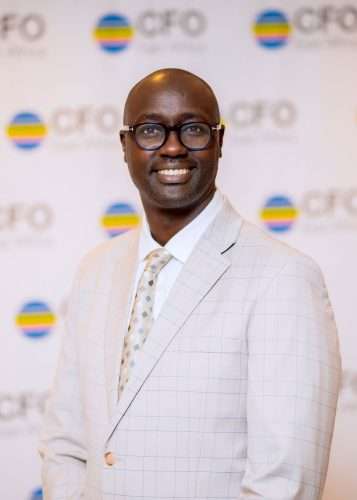
For Louis Owoko, finance goes far beyond explaining past performance. Reflecting on lessons from his time in the public-sector and the startup ecosystem, he explains why modern finance leaders must think like business strategists.
Louis Owoko’s instinct to challenge assumptions has ushered Gebeya through successive strategic pivots. For him, the CFO role goes far beyond explaining past performance. It means questioning how things are done and helping the business decide what comes next.
“My career has evolved from reporting what happened to influencing what happens next and what gets reported. Anyone who knows me will tell you I’m not a status quo person. Some of the pivots we’ve made at Gebeya came from making people uncomfortable, and at times those conversations were heated," he says.
That discomfort, Louis believes, can be productive. As he sees it, a finance leader must be prepared to challenge assumptions while remaining constructive and focused on what the business needs. It is easy for teams to become absorbed in day-to-day execution and miss the warning signs or changes emerging ahead.
Louis joined Gebeya as CFO when the company operated a talent marketplace. He questioned whether the model could scale sustainably. It was cash-intensive and depended on continually acquiring clients and placing talent. The experience sharpened his ability to discern between growth and genuine value creation.
“To create value, the strategy you adopt must actually deliver it. Value must be built over time and sustainably. You cannot create significant value in year one only to struggle or stand still in year two. The progress must be demonstrable, consistent and sustainable," Louis explains.
Lessons in adaptability
The marketplace also exposed the cost of growth without sufficient financial discipline. Clients sometimes took three to six months to pay, while Gebeya still had to pay talent in the meantime. Bridging that gap required financing, and the cost of that financing could erode the margins the business expected to earn.
“You can grow as a company and still fail if you are not financially disciplined. When you account for the cost of financing delayed customer payments, the margins you thought you had can disappear. You may be growing revenue while destroying value," he says.
Louis’s approach to challenging inefficient structures took shape well before Gebeya. At Kenya Railways, many financial processes were paper-based and manual. He pushed for automation, but progress in a public-sector environment was a multi-step process involving ministerial approvals and board support. Even relatively small initiatives could take months to secure.
His subsequent experience in consulting and entrepreneurship reinforced the importance of understanding the whole business. In 2019, he started a business with two friends, but the disruption that followed with Covid-19 became another formative lesson in adaptability and execution.
“When hiring, recruit people who complement you, not people who look like you. None of us is perfect. And as a finance professional, you must understand the business in depth. You can be brilliant at finance, but if you do not understand the business, that brilliance helps nobody. Finance sees across the organisation and must be able to advise it," he says.
The commercially curious CFO
Louis' first boss gave him the autonomy to repair a finance function that had failed audits for six consecutive years. Within seven months, the team resolved the issues and achieved a clean audit for the first time.
“Sitting at a desk from 8am to 5pm does not automatically equal output. Once expectations and KPIs are clear, I give my team autonomy to deliver. If you deliver, I do not need to see your face every day. I also believe in participative management: we discuss departmental objectives together and let people define how they will contribute," he says.
For Louis, one of the defining developments in his career has been becoming commercially curious, which means moving beyond the identity of a finance professional to thinking like a business leader. That means spotting hidden risks and assessing whether the organisation has the capabilities and resources to pursue them.
“I may be a finance person, but 80 percent of the time, I am a business person. I look at operations, the risks we may be missing, how we can grow the market, what resources we have internally and what we lack to move the company forward. That strategic orientation is a major highlight of my career," he reveals.
He expects this mindset to become even more important as technology reshapes finance. The CFO of the future, he argues, must understand how the business creates value and must be a trusted strategic partner to the CEO, the board and investors. That also means understanding how emerging technologies such as AI affect everyday decisions.
“The CFO of the future must understand the business inside out, not just finance. Commercial curiosity means understanding how the company creates value, acquires customers and grows profitably. The CFO must be a key strategic partner to the CEO, the board and investors, translating complex issues into actionable strategy. And as technology evolves, CFOs must understand emerging tools such as AI and how they affect operations, finance and risk.”
Return to the soil
If he were not working in finance, Louis says he would return to commercial farming. Before university, he grew tomatoes and vegetables commercially. Between January and March, when dry-season shortages made fresh produce scarce, he learnt to time supply to market demand.
“Farming is a whole enterprise. You manage cash flow, inputs, field risks, labour and market timing. During the dry season, fresh produce was scarce, so supplying vegetables at the right time could meet overwhelming demand. I would readily return to it," he explains.