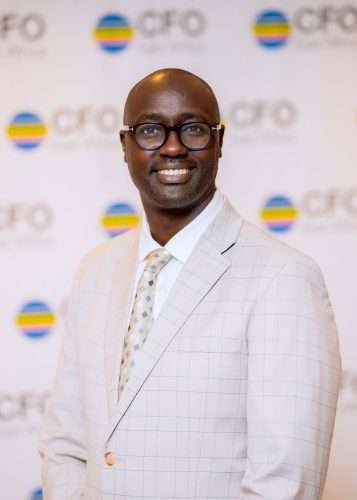
In the past, CFOs were seen as financial gatekeepers who managed an organisation’s costs and risks. Today, finance leaders are expected to drive strategy, innovation, and growth. American Tower Company CEO George Odenyo, MAT Abacus Business School principal Professor Samuel Sejjaaka, and Strathmore University senior lecturer Professor James McFie weigh in on how finance executives can drive value and shape the future of their companies.
The ability to create value beyond the finance function has quickly become the true measure of success for CFOs. Increasingly, organisations are on the lookout for finance leaders who are able to do more than report on past performance. For MAT Abacus Business School principal Professor Samuel Sejjaaka, this means CFOs must redefine their role.
“You are not just a CFO, you are the chief value officer. I want a CFO who is critical in terms of thinking. I want a CFO who is innovative and accepting of new ideas. One who is willing to experiment and try new things,” he says.
His perspective is an indication of the growing expectation that CFOs must move beyond financial oversight and become strategic partners to their CEOs and the business. In his view, finance executives must develop a deep understanding of their businesses and offer more than just financial acumen.
In the same vein, American Tower Company George believes a good CFO should be able to challenge how the business operates to ensure it remains competitive. He warns that CFOs who are slow to evolve run the risk of becoming irrelevant.
“Of course, you need to know your numbers well, but you also need to know the business, understand the business model, and be able to challenge how the business is operating so that you can add value to business growth and success,” he says.
Industry knowledge
Strathmore University senior lecturer Professor James McFie concurs. He believes that true value creation is the result of deep knowledge of the industry.
“The CFO has to have the fundamentals absolutely right. He has to understand the business he’s working in. Sometimes new regulations come in. Without this foundation, even the most skilled finance professionals may struggle to make meaningful contributions,” he says.
This approach has risen in popularity as AI, automation, and analytics continue to transform financial management. Samuel points out that CFOs now have access to large amounts of data and should leverage analytics to advise their boards on business decisions. As companies generate vast amounts of data, they amass a treasure trove of potential value that he notes can prove useful. By analysing this data, CFOs can improve their decision-making and identify new opportunities for growth.
According to James, CFOs must also be exemplars of ethical conduct. He notes that the buck stops with them, requiring them to resist all attempts at coercion and navigate ethical dilemmas with wisdom.
“One of the difficulties is that sometimes you can be a CFO and realise that the managing director or a principal shareholder is asking you to do something that adds no value to the business. To answer that person in a way that avoids doing what they demand requires an incredible amount of ingenuity. CFOs have to be clever in dealing with such situations. They have to be wily characters, as innocent as doves but as cunning as serpents,” he says.
Driving growth
Samuel also highlights leadership as another critical component of value creation. He advises CFOs to collaborate with their CEOs and board to ensure financial strategy is aligned with business goals. This way, they can build relationships across the organisation and enable growth.
“You are the main advisor to the CEO. I want to see that you are able to add value to the ideas that the CEO shares with you,” he says.
For James, the ability to build and lead high-performing teams is equally important. He notes that an effective finance department is a reflection of its people. Mentoring future finance therefore ensures that the organization remains agile and prepared for future challenges. But in George’s opinion, the real challenge is finding individuals who can provide meaningful insights.
“Many people are qualified in finance, but do you have access to good talent that can support you with accurate and timely data? Building a strong finance function means mentoring and ensuring the team is equipped to support business goals,” he explains.
Finance leaders must also contend with macroeconomic and geopolitical risks. According to James, adaptability is a defining trait of a successful CFO. In his experience, the present business environment requires CFOs to think ahead and be proactive.
Environmental, Social, and Governance
“CFOs need to constantly learn and adapt.. They also need to be able to manage risk effectively and ensure that their organisations are prepared for any potential challenges. Those who remain proactive, rather than reactive, will be able to guide their organisations through uncertainty,” he says.
For George, this means striking a balance between cost-cutting and growth.
“Controlling costs is important, but how do you control costs without killing growth? The ability to allocate resources strategically, investing where it matters most while maintaining financial discipline, is what separates exceptional CFOs from the rest,” he says.
Beyond their organisation, CFOs are also expected to consider the broader impact of their activities.
“If the environment is not sustainable, your business won’t be sustainable. Finance leaders have access to vast amounts of data that can be used to drive ESG initiatives and advise the board on long-term sustainability,” he says.
Overall, finance leaders must now wear many hats. Samuel therefore believes the future belongs to those who embrace these changes.
“I want a well-rounded CFO who is a chief value officer because you are like the counsel to the CEO. You are the main advisor to the CEO. This is what separates the best CFOs from the rest,” he says.