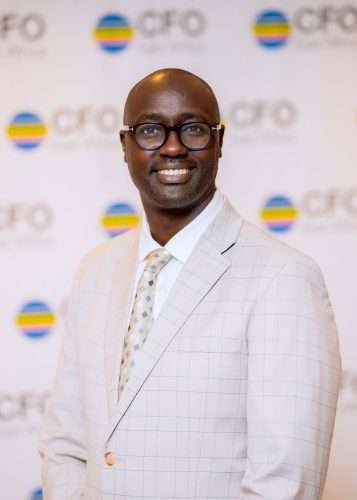
As a child, Ampersand head of finance Collins Otieno had pictured himself as an engineer, a far cry from his present role. But time and experience have imbued him with a passion for social impact and the uncanny ability to bloom wherever he is planted.
Collins Otieno describes himself as a ‘utility player’. Over the last 16 years, he has worn many hats, shifting from internal audit to quality management to full-spectrum financial management.
“Where there is need, I gravitate there. That’s how I got into the quality management role and then into the more finance roles where I was handling production of financial statements and coordinating audits across the group,” he says.
Collins began his career at KPMG in Nairobi, where he learned to see finance as an industry professional would. As an audit associate, he gained an understanding of how businesses operate, learning about the inner workings of organisations in different industries. But soon, he began to crave something more hands-on.
“I had grown well enough in that role and developed some interest in going to the other side. Instead of being the guy who’s reviewing and making recommendations, I wanted to be the guy who’s getting stuff done. So when Davis and Shirtliff came calling, I joined them on an internal audit role,” he says.
At Davis and Shirtliff, Collins eventually transitioned to a quality management systems role, playing a part in securing the company its ISO 9001:2015 certification – the first in Kenya at the time. But while he thrived in the corporate world, he felt an increasing pull towards finance and decided to go back to the classroom.
A change of mindset
“When I stepped into my first finance class in my MBA programme, I said, ‘Yes, this is the stuff I want to do’. From that point on, I started dislodging slowly from audit and trying to look for more finance tasks,” he says.
The opportunity came when a friend told him about a start-up, Pula, that was looking for a finance manager. This would be a complete shift from routine cycles of a mature organisation to the unpredictable and agile energy of a startup. He began to set up the finance function from scratch, building systems, hiring a team, and designing processes with the overall goal of de-risking small-holder farming.
“I developed this analogy in my head. Corporates are like complete buildings and we are doing maintenance work. But startups are construction sites. You’re building from the ground up,” he says.
Although the startup world was entirely novel, Collins takes pride in being able to point to a process or framework and say he built it.
“If you just do your stuff, you’ll make an impact. There is a framework document sitting somewhere that was developed by Collins. That’s the good thing about being in a startup. You set things up and they go with your name printed on them,” he says.
Passion for lasting change
This hunger for creating social impact was the force behind Collins’ move to Bboxx and eventually Ampersand, whose mission is to reduce carbon emissions by enhancing the adoption of electric motorcycles in East Africa.
“One of the unique features of Africa is our public transport system. We have millions of motorbikes on the road releasing tonnes of carbon into the atmosphere. Ampersand is helping correct that while at the same time making the micro-economics of it make sense,” he says.
Collins knows first-hand what it means to grow up without access to clean energy. As a child in his native rural Kisumu, he studied by the light of a tin kerosene lamp, and walked long distances to school on his bare feet.
“I grew up in what I would call abject poverty. I’m not exaggerating. My eyes turned red and the roof turned black because of soot released by the lamp. When that kerosene ran out at 8:30 pm, you had to go to sleep,” he says.
After university, Collins spent time volunteering with Fellowship of Christian Unions (FOCUS). The experience, which lasted a year, left an indelible impression.
Making a difference
“They have this programme called STEM, which stands for ‘short-term experience in ministry’. I was attached to a few universities where I worked with student leaders and helped organise training and capacity-building sessions. There was very little monetary reward. It was about service. They paid my rent, gave me a small stipend, and reimbursed my airtime. That was it,” he says.
His time at FOCUS unlocked a window into the power of mentorship and shaped how he builds teams in the workplace.
“It gave me the opportunity to do a whole lot of work for no money at all and just to see the impact. It showed me that I’m deeply motivated by making a difference,” he says.
That desire to make a difference carries into how he leads his team, as he believes everyone should be exposed to different aspects of the finance function. He is deliberate about using performance reviews as coaching sessions, breaking down even the simplest tasks into teachable moments.
“I entertain a lot of questions from my team. I use our office whiteboard to walk them through concepts. I want them to understand how everything connects, how a late posting affects reporting, how reporting affects investor confidence, and how all of that determines whether the business grows or struggles,” he says.
Dramatic turnaround
But Collins’ journey has not always been smooth. Early in his career, Collins received a poor performance review. The delivery of the unexpected feedback compounded his dismay, putting him in a panic. When he had recovered, the review became a turning point. He reflected on the feedback, changed his approach, and has never had another negative review since.
“My manager didn’t mince his words. It was a bit rough. But it helped me. It came early in my career, thank God. I realised that performance isn’t just about doing a few things right. It’s a mindset. It’s a daily discipline,” he says.
Although relocating to Rwanda to take up the role at Bboxx and later Ampersand was not without its challenges, Collins and his family have connected with various communities in Kigali and now feel right at home. This includes church, Kenyans in Kigali and fellow professionals.
"What made the difference was finding a community here. Plugging into that support system was critical," he says.
The father of three relishes his evenings, which are spent helping his daughters with their homework, reading them bedtime stories, and spending quality time with his wife, who is a practicing architect.
“When I close my laptop and I’m home, I’m giving them full attention. Time spent with my wife is one of the most rejuvenating things. That’s how I refill my tank after a busy day at work. In my campus days, I played the keyboard and taught vocals. I wish I could go back to doing live music. I’m still hoping for a time when I will go back to that hobby,” he says.