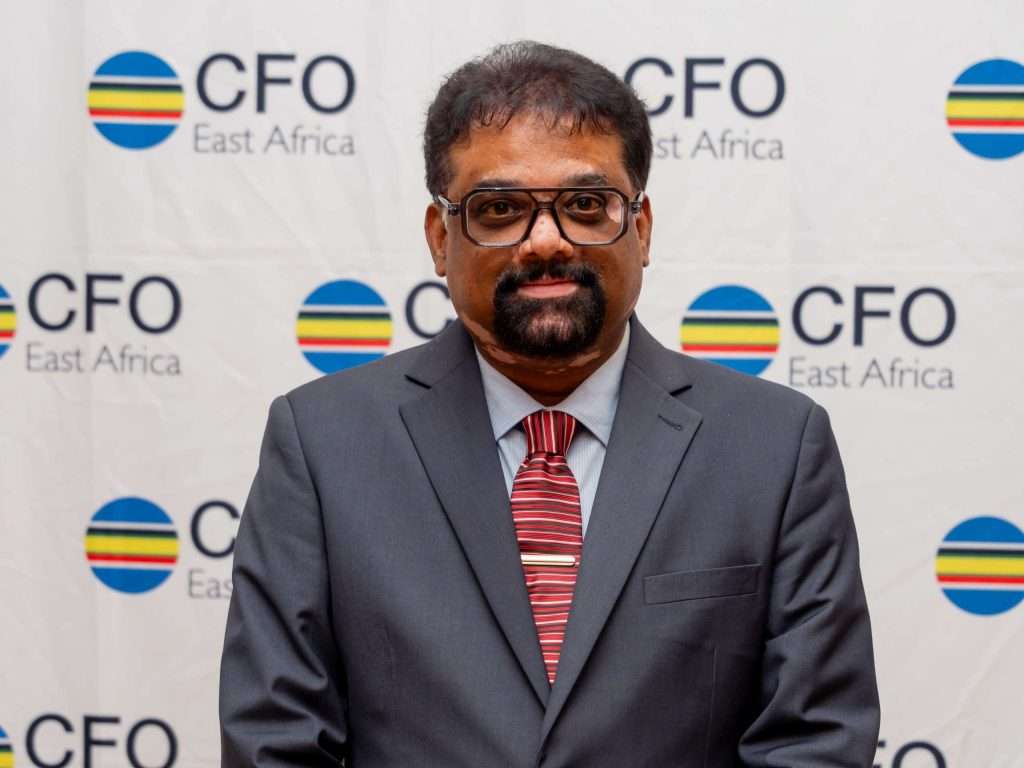
Bobby Sumanth, group director of finance at Amsons, has spent 26 years building his career across East Africa, where his role has grown beyond finance to leadership. He believes the strongest finance leaders are those who prepare others to lead.
In January 2000, Bobby Sumanth arrived in Kampala knowing very little about Uganda or the region. He had taken a job as finance head at a fish processing company, encouraged by his father to go despite the warnings of possible unrest in Uganda then. Two months after arriving in Kampala, he asked his driver to take him to a church, where he soon became a member. The congregation welcomed him, and after noting that he was presumably good with numbers, asked him to take over the treasury. At the time, Bobby was the only foreigner there. He managed the treasury for the seven years he spent in Kampala and is still in the WhatsApp group the community uses today.
“Back in India, we did not know much about Africa then. I have to be honest, I did not know much about the region. But my father and my family encouraged me. He said nothing will happen, you just have to go and pursue your career, even though other people said there were issues,” he says.
Now, having lived and worked in East Africa for 26 years, he describes the experience as extremely fulfilling both professionally and personally. Bobby is the group director of finance at Amsons Group, a large diversified conglomerate based in Dar es Salaam, Tanzania, with operations spanning five countries in the region. Since joining the group in January 2008, he has lead several functions, working closely with the board on strategic investment and M&A.
The group’s revenue stands at $1.5 billion for 2025 and its two principal businesses are the importation and distribution of petroleum products, which account for 61 percent of group turnover. In December 2024, Amsons wholly acquired Bamburi Cement in Kenya, one of the oldest and most prominent industrial operations in the country, marking one of several recent acquisitions.
“The East Africa Portland Cement acquisition in Kenya concluded in December 2025. In the meantime, we also announced a major solar power project in Zambia, a one-gigawatt project where the MOU with the government has already been done,” he says.
Solid foundations
Before moving to East Africa, Bobby spent five years at Dr. Reddy’s Laboratories in India, one of the country’s largest pharmaceutical multinationals. He rotated across every sub-department within the finance function, including procurement finance and taxation. The experience gave him a close look at how organised, specialist-led teams operate. It also influenced his thinking about what it means to lead a finance function in ways he did not fully appreciate until much later.
“My role is not just to do my own work; I have to create the next batch of people, the next set of people I can delegate to. When I’m outside, like when I went to Rwanda, I need people to be my right hand and eventually my successors. You must ask yourself how to mentor them and give them proper training to come up to the level where they can take up some part of my job when I’m not around,” he says.
His father, a bank manager who worked at the Reserve Bank of India and later retired from the Central Bank of India, was the person who persuaded him towards commerce in the first place. He took the advice and did not look back. Sadly, his father has since passed away.
“I used to get good marks in biology, physics and chemistry. Normally when you do that, you think you will go to that stream. But I took the advice positively. I said, let me give it a couple of years. If I’m not finding myself mentally inclined, there is always a chance at that age to shift your curriculum,” he says.
People first
At Amsons, Bobby often gathers groups of five to 10 people and has them present their own work on screen. As he sees it, when his team can present independently, they can run the finance department while he is travelling or in meetings elsewhere. Although he calls it a selfish motive, his team has found the practice highly beneficial.
“I don’t take the report and present it myself. I tell the guys we will have some practice sessions. We sit in small groups and correct them on certain things, such as folding the arms or putting their hands in their pockets, as well as the finer points of presentation skills, public speaking, knowledge of the topic, and having good control of the language,” he says.
When Bobby first arrived in Uganda, he found that his professional qualifications had prepared him for the technical work but not for building trust across a different culture. He began sitting with colleagues individually and in small groups, asking them what they needed from him. It took time, but it became the approach he has carried through every role since.
“People skills are not taught; they are caught. Not having learnt the interpersonal skills and having to learn them myself on the job was challenging at the beginning. But as days, months and years went by, people understood, and I got very good cooperation from wherever I’ve been,” he says.
Bobby also encourages his team to develop passionate hobbies. He enjoys photography in his free time and has built up a large collection of equipment over the years. Although the photographs are not published anywhere, he keeps them for himself and his family. His argument is that creative work outside the office gives a person a different perspective, and that perspective feeds back into the way they think at work.

Staying curious
The week before this interview, Bobby turned 56, spending the day in Kigali. More acquisitions are in discussion and the next year, he says, will be as busy as the last two or three. He joined the CFO East Africa community recently and describes it as one of the better decisions he has made. He often reads what other members write and attends their events, saying the exchange has opened up his thinking in ways he did not expect at this stage of his career.
“Even at this age, I tell people that learning never stops. Success is not a destination; it’s a continuous process. You think that you have achieved something and you sit on it, but that’s not going to help. When I meet with all the CFOs who are in wonderful companies doing great work, I read what they write about certain aspects of finance. It is still a big learning curve for me,” he says.