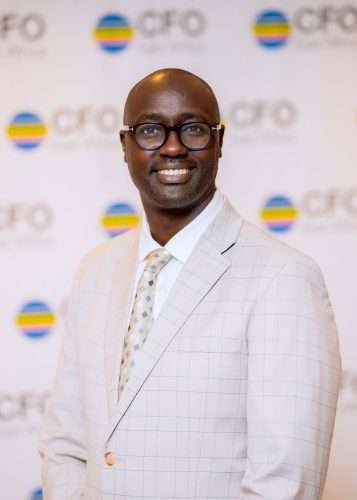
Andrew Bugembe, CFO of MTN Uganda, has been in the telecom industry for over 25 years. He started in Uganda in 1998, spent a few months in Rwanda, moved to Ghana for four and a half years, then to Liberia, Congo Brazzaville - and finally returned to Uganda in 2020, just before the Covid-19 pandemic began.
Andrew was one of the speakers at the CFO of the Future Summit held in Nairobi in August where he shared his thoughts on the trends finance leaders need to keep up with. This article captures the first of two parts of his extensive sentiments.
“When you look at the role of finance, or even what finance was back in the day compared to today, it’s almost night and day for some of us, and the impact of what we talk about is very real. When we say the value of a CFO, it’s not just to the CEO and management – for a CEO, you're like a wingman,” he said.
“You know, back in the day, you just said ‘no’. I tell my team, saying ‘no’ is easy. The issue is ‘why?’ Or, if the no is overridden, what is the alternative? Back then, there were no answers; it was just ‘no’, because of no budget. Today, and for the future, the CFO is more of a strategic partner, like a wingman. You fly into battle, and your duty is to protect the company. The wingman ensures everything is in order, and if there’s a problem, they know what needs to be done. That's what we do, or should do,” he added.
Andrew believes that the term chief finance officer is now outdated and should now be replaced by chief value officer. He opined that many people still see finance executives as 2G in terms of accounting, yet they have progressed to 4G and are almost reaching 5G. Being a strategic partner means looking beyond traditional accounting.
“Make no mistake, we cannot lose sight of what we call the ‘ugly stuff’, because if that falls apart, you're out. The difference now is that technology has automated many processes, but every decision you make should account for the long-term impact,” Andrew advised.
Options and decisions
He went on to observe that the beauty of being in finance is that one often knows more than anybody else about what happens throughout the company. This is a crucial advantage. The skills needed for the future will be about the ability to analyse and see patterns not obvious to everyone, and use experience and intuition to make decisions.
“On the question of digitalisation, back in the day it was something that we found a bit strange. It was only Covid that made it mainstream. Even now, presidents use Zoom and trust it. We can work from home, have sales teams or tender committees work from home. With AI, a meeting like this can happen without the need to write anything down. AI co-pilots are doing a good job, and they’re getting better. Your meeting gets summarised with action items and deadlines. Your job now is to understand the options and make decisions,” Andrew said.
With the current technological landscape, Andrew believes that the key issue is the skillset needed for the future. Data has become supremely important such that if the internet goes off, the children of today struggle to watch television.
“Life has completely changed. While we're still struggling with Gen Z, I'm more worried about Gen Alpha. Their mindset is different. Even kids as young as 10 or 15 will tell you: ChatGPT is better than gold, they've already figured it out. Schools are developing ways to ensure kids don’t use AI. You can imagine the generation ahead – they don’t have to remember debits and credits; they just punch it in, and the output ensures they can make a difference. So, what becomes key is learning agility. We need to unlearn and relearn, while not forgetting our history and experiences, because those drive our instincts,” he stated.
Andrew recalled how learning agility was important for him when he returned to Uganda in 2020. MTN was in the process of listing, and he had to look at the team and critically questioned whether he had the right people to serve a changing company. He also had to self-reflect on whether he had the right skills to run a listed company with investors who have used their hard-earned money to purchase shares in the hope that management will achieve a return.