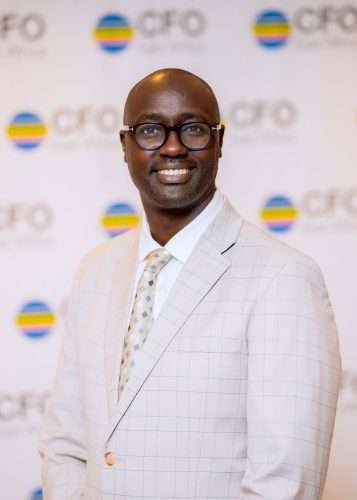
In his remarks at the CFO of the Future summit held in Nairobi in August, MTN Uganda CFO Andrew Bugembe shared insights on risk management amid the increasing adoption and reliance on artificial intelligence (AI).
As artificial intelligence becomes increasingly popular in and out of the workplace, businesses are confronted with the need to adapt. For finance leaders, many of whom are risk averse, this presents a unique challenge. This does not apply to Andrew, who encourages his peers to embrace AI, to automate business processes, freeing up time for higher-level decision making. He advised finance leaders to borrow a leaf from the youth, noting that Generation Alpha, born between 2010 to 2024, are more receptive to technology.
“At MTN, we’ve digitalised business intelligence massively. You have a heat map of the country, where you can measure airtime loads per hour. If something drops, you know what happened. When I was in Ghana, the sales guys used to say, ’It’s rained, so sales are down.’ I’d think, ‘Really? Didn’t it rain last year at the same time? Why were sales up then?’ With time, technology tells you this. During Covid, every time we were locked down in Uganda, you could see a surge in activity as soon as we reopened, almost like a stock market opening. You could see how money moved,” he explained.
However, Andrew called for caution in managing risk, saying CFOs must anticipate the worst. He noted the need for redundancies in business operating systems to guard against unforeseen events, saying overreliance on technology could expose businesses to great risk.
“With everything online, even having one switch in a city is dangerous. You need multiple switches, and you must be able to reroute traffic within seconds. This requires investment in fibre networks. If the Kenyan side is cut off, can you reroute through DRC or Rwanda? Being offline for a few minutes is costly,” he said.
The use of digital technology presents unique risks, with cybercrime posing an increasing threat. As artificial intelligence constantly evolves, new cyberthreats emerge. According to a Cyber Ventures report, the cost of cyber-attacks globally will exceed $10 trillion in 2025. Andrew advises finance leaders to create advanced approaches to risk management to keep companies resilient.
“In Uganda, because of mobile money, you'd be shocked at how many hacks we stop per hour. Hackers are constantly improving, even with system upgrades,” he said.
Managing working capital
According to Andrew, most finance leaders and companies tend to focus only on the income statement, an approach he believes is flawed. He noted that the balance sheet represented the true position of a company, saying it was crucial for CFOs to manage cash.
“You can be profitable but cashless. If you don’t manage your working capital – and Covid made this clear – you won’t survive. In telecom, Chinese vendors used to give a lot of credit, but that has changed. They now expect payment upfront and understand the power of cash and working capital. For CFOs, profitability is important, but managing cash is crucial. Cash is still king. Some things don’t change – a debit will always be a debit, and a credit will always be a credit,” he said.
Andrew also highlighted the need for sustainability as ESG investing, which shot to popularity at the height of the Covid-19 pandemic, gains ground. This comes as demands for sustainability disclosures in Africa increase, with communities demanding transparency and accountability from businesses
“You can't grow if your community isn't growing. Back in the day, we only had foundations, but today, going for green loans, for example, can secure better terms. In telecom, we run up-country towers, often without consistent power. Today, these sites are automated, using solar, batteries, and generators in rotation. If one fails, the next kicks in automatically. It’s all about sustainability,” he said.
Diverse perspectives
Andrew predicted a radical shift in finance, saying finance professionals would face a vastly different set of demands in the future. He advised finance leaders to build diverse teams composed of skilled people who offer a wealth of perspectives to draw from.
“As a leader, I’m as good as my team. I can be ruthless, and I try to get the best, because I don’t have time to do everything myself. I don't have time to spend hours on reports like I did when I was younger. You must hire skilled people to handle that. I recently did a course at Harvard in May, and in our group of eight, we had eight different nationalities. The diversity of thought was obvious, not just in terms of nationality but also gender. It's not about being the brightest – you need a team that’s smarter than you, and your role is to synthesise their ideas. The conversations were so rich and diverse,” he said.
According to Andrew, listed companies also require an investor relations manager who understands stakeholders and how they think. He envisioned a drastically different profession, where finance executives, traditionally trained to crunch numbers, would shed their suits and ties for jeans and dreadlocks, while providing immense value.
“If we don’t have the right skills or the right people, we can't succeed. Change is inevitable, but what’s more important is learning agility. Once we have that, the rest is manageable,” he said.