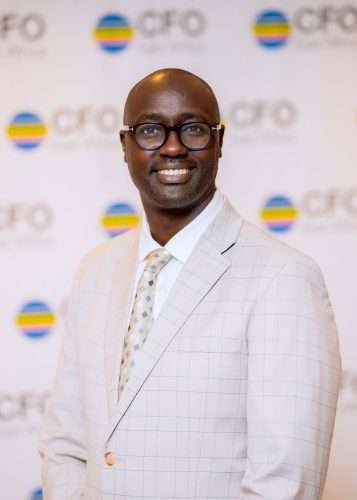
At the CFO of the Future Summit in Dar es Salaam, more than 100 finance leaders came together to examine how sustainability and technology are changing the finance function. Across the evening, speakers explored what it means to help shape the future of a business.
The numbers still matter, but at the CFO of the Future Summit in Dar es Salaam, it quickly became clear that they are no longer the whole story.
The evening began with a panel that featured Hillary Godson, CFO at Jubilee Life Tanzania, Veronica Magongo, CFO at I&M Bank Tanzania, and Ernst Vriesendorp, CFO at Bouwsteen Energy. Their conversation ushered in a discussion about a role that is widening without losing its foundations.
“We are past that time where we look at numbers with a backward or rear view. The expectation right now for CFO is way higher. The ability to have forward-looking value addition is what sets the difference,” Hillary said.

This quickly brought technology and sustainability into the picture. For Veronica, these are no longer future considerations sitting somewhere on the horizon. They are already part of the CFO’s job.
“Technology advancement and sustainability are here to stay. They are part of what we do. We’re talking about the future, but these are things that we need to do now, and we need to prepare,” Veronica said.
Co-piloting business strategy
From there, the conversation moved into the first panel, Lessons learnt in our sustainability journey, with Derick Lugemela, CFVO at Stanbic Bank Tanzania, Neema Kiure, partner at EY, and Balaji Raman, cFO at Tanzania East Africa Gateway Terminal. The three brought different experiences to the question of what it takes to turn sustainability into something that shapes the business.
For Derick, that starts with finance taking a much more active role in the business itself. At Stanbic Bank Tanzania, he said, the finance function is already working alongside the business rather than simply reporting on what has happened.

“Value creation is pillar number one of the finance unit in Stanbic Tanzania. We already co-pilot our businesses. We have to drive and create the strategy, and we have to oversee the execution of that strategy,” Derick said.
Neema took that idea a step further, pushing back against sustainability remaining a conversation that happens inside boardrooms. The real test, she said, is whether it changes what people do every day.
“We need to get out of that normal talk about sustainability, and me and you and every one of us together need to go and implement this sustainability from our homes to the offices. Then we will see the success that we need,” Neema said.
Driving boardroom decisions
Balaji then offered a striking measure of just how much the CFO’s position has changed. His experience detailed what now happens when the CFO walks into the boardroom.
“Ten years back, when I was a CFO, I used to sit behind when I did a board meeting. I used to be on the back seat. Today I am the one who drives the board. CEO sits behind me,” Balaji said.

Innocent Yonazi, director of investor relations, sustainability and corporate communications at NMB Bank, followed with a partner address on the changing CFO mandate, before Vincent Onjala, partner at KPMG East Africa, turned the spotlight to the skills finance teams will need as technology takes over more routine work.
For Innocent, the change is adds more responsibility around it rather than abandoning it completely
“The mandate of the CFO has not really changed; it has widened. The CFOs are still regarded as the custodians of liquidity. You are still regarded as the architects of capital,” Innocent said.
Human competencies and commercial realities
By the time Dr Allen Mutono, CEO of the IALE Institute and author of The AI Toolkit, took the stage after dinner and lively group discussions, the conversation had moved into the future of work. His keynote challenged finance leaders to think about AI beyond the tools themselves and focus on the work humans should continue to own.

“There are five competencies that only humans can have, which is courage, creativity, curiosity, communication, and compassion, which machine cannot have,” Allen said.
This idea carried into the final panel titled 'The evolving role of the CFO', with Patrick Nanyaro, CFO at CFAO Mobility Tanzania, Isabella Mwambalaswa, CFO at Mowara, and Bernard Tesha, CFO at Absa Bank Tanzania. The discussion brought the evening’s big themes back into the practical decisions finance leaders face inside their businesses.

Isabella spoke about using AI for data analysis across logistics, energy and infrastructure, while Patrick brought the conversation back to the realities of commercial decision-making. The question, ultimately, was whether a technology or sustainability strategy works for the business and its customers.
“As much as it is the future, to some extent, it’s also very much the present. But there is a need to understand that there is a convergence between the market requirements and what we can provide because we are a business. We need to sell to be able to be sustainable, but if we bring cars that we cannot sell, we’re locking up cash,” Patrick said.
The event was made possible by principal partners KPMG and NMB Bank and associate partners EY and Kora.