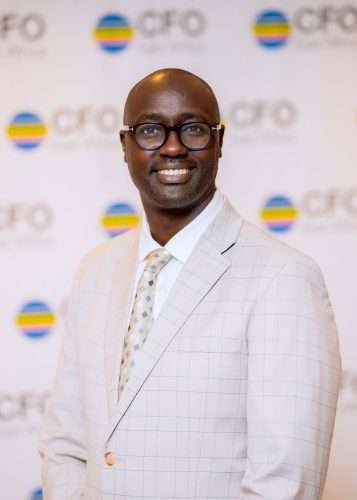
Weetabix finance director Dr Sebastian Nthama, PhD reflects on how navigating a war zone in Ethiopia shaped his resilient approach to leadership. He also reveals why he returned to university to pursue a law degree after 32 years in finance.
When war broke out in northern Ethiopia in 2021, Dr Sebastian Nthama’s phone would not stop ringing. His mother called daily, anxious about her son working there. But the news coverage bore little resemblance to reality on the ground.
At the time, Sebastian was CFO of a wine business in Addis Ababa. The company was going through multiple challenges, including access to scarce foreign currency, besides keeping the business going,” he recalls. Language and cultural differences with the Ethiopians often arose and needed to be delicately balanced.
“Trying to keep two or three pieces of work going at the same time was the biggest challenge. The systems in Ethiopia are really arcane. You have to fight it out with essential goods to be allocated dollars,” he says.
When rebels announced they were marching into Addis Ababa, Sebastian returned home to work with an investor seeking a CFO in Nairobi.
The path to the boardroom
In secondary school, Sebastian excelled at commerce and principles of accounts, earning distinctions that led him to pursue economics at A-level.
“I just loved it. I haven’t really thought of changing, although I’ve just finished my first semester in law at the University of Nairobi. I want to see how I can combine both law and finance in my post-formal employment phase,” he says.
Just before graduation, PwC came to recruit and selected three students, Sebastian being one of them.
“I finished my last paper in the final days of November 1993, and then the following Monday I was working in an audit firm. After about 4 years, I moved to internal audit in the Nation Media Group. Before I had finished about two years at Nation Media Group, I saw an advert promising a lot of travel. I applied to BAT. They doubled or tripled my salary and asked me to get a passport. I had never left Kenya before,” he says.
During his time at BAT, where he spent 21 years, Sebastian travelled to several countries, including Australia, Malaysia, Turkey, Egypt, South Africa, Malawi and Nigeria, besides numerous destinations in Europe.
“When I engage people who have really only been in Kenya, they don’t understand the international dynamics of trade and development. I can relate to how people in South America do business because I’ve worked with them,” he explains.
High-pressure transformation
He also led an 18-month transformation project at BAT, during which the team changed how the business operated across Eastern and Central Africa. The project, in turn, left the team changed for the better.
“It was high pressure. I had a team of 36 people including HR, finance, operations, IT and data. I think I lost a few kilos and my hairline receded. But seeing people join fresh from university, handholding them for four or five years, and then they get a substantive appointment, that for me has been a standout,” he says.
In 2019, Sebastian took a leap that baffled many. He left BAT to start a water purification business in Kitengela. But within six months, the Covid19 pandemic hit, throwing everything into limbo. The business has since pivoted and continues to be vibrant, a comeback Sebastian sees as a lesson in resilience.
“Even my mum never understood it. But I kept the business running. I put together a team and systems. It still works perfectly fine even in my absence,” he says.
The Mandela approach
Sebastian credits Nelson Mandela’s Long Walk to Freedom with shaping his approach to life. He discovers new ways to see things each time he goes back to the book.
“Mandela still fascinates me. He was jailed for 27 years, came out and forgave his tormentors. I still believe there is no transgression I cannot forgive, even in a work setup. As long as I believe it was a genuine mistake, I will always leave it aside in the interest of making progress,” he says.
To this end, Sebastian has learned what drives each person on his team, and he now maps their strengths against their roles. He usually assigns projects designed to reveal how someone delivers.
“I find that works more often than not. Of course, with Gen Zs you have to remodel it because initially, they don’t want to open up. What used to work with millennials is not necessarily what is going to work with Gen Zs,” he explains.
Watching younger finance professionals navigate their careers differently has prompted Sebastian to think about his own path. If he could advise his younger self, he would be more open-minded. Having spent his career in large organisations, he now recognises the value of smaller outfits where finance professionals handle end-to-end operations.
“In my earlier years, I was fairly selective with which organisations I would work for. I wanted big, established businesses. But if I had worked in a small business where I would be the finance controller, I would have learned how less formal businesses operate. I’ve been brought up in fairly bureaucratic environments, and I suspect that has stuck with me,” he says.
The AI imperative
At Weetabix, young team members are already automating sales order processing. The company’s customers send orders via email, and the system processes them overnight.
“It’s already working in that section of the business. So I am asking myself, what does that mean for finance? We need to deploy AI sooner and quicker so that we can learn how it works before it expands to look very different,” he says.
At Weetabix, Sebastian has found what he describes as a fulfilling role, where he can interact with virtually any process.
“When I bring that knowledge and experience and I see it benefiting people, when we team up and improve a process which results in higher sales, better controls, that gives me personal fulfilment,” he says.
Currently, Sebastian is pursuing his law degree. In three to four years, he hopes to combine both disciplines and provide professional services in corporate law, taxation, mergers & acquisitions as well as conveyancing.
“I asked myself, what is it that I could do without throwing away my long finance experience? I came to the conclusion that if I studied law and leveraged my finance and leadership experience, I think I would make a good commercial lawyer. After 32 years in finance, I need to jog my memory in new areas, even if for a change,” he says.