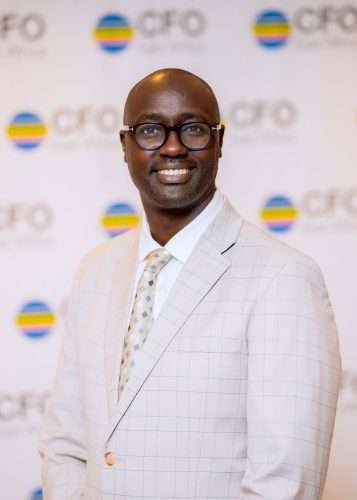
At the recent CFO East Africa Uganda launch, EABL group CFO Risper Genga Ohaga participated in a panel discussion where she offered her insights on the balance between technical skill and adaptability, encouraging CFOs to take more risks to catalyse the growth of their organisations.
As chief accounting officers, CFOs are accountable for the financial wellbeing of their organisations. However, many organisations outsource their accounting, relieving CFOs of these day-to-day tasks. Remarking on the need to ensure a company’s affairs are above board, Risper warned that CFOs must maintain oversight of these processes nonetheless, as the buck stops with them.
“For somebody who I don't even see running this, they're not in the business, they don't know anything about the business and they’re just running the tables. And I ask a question, and because they didn't know what was going on, they declare it differently. So, for me, it's just also making sure that as you move away from the technical, have systems, structures, processes that support you, then you spend the least time on that, and so that you are adaptable,” she said.
According to Risper, this shift allows CFOs to devote less time to everyday tasks and focus on the bigger picture. She encouraged finance leaders to take more risks, noting that finance professionals tend to be risk averse. Risper, who has spent four years in South Africa and another four years in Zambia as the finance director of Absa, revealed that people often baulk at the discovery that she moved from country to country with her children in tow.
Interestingly, Deloitte & Touche’s North American CFO Signals survey conducted in the first-quarter of 2024, for instance, found that 60 percent of CFOs are indeed risk-averse, with the macroeconomic and geopolitical environments dominating their list of concerns. To turn the tide, Risper advises taking smaller risks to drive oneself out of one’s comfort zone.
Compelling storytelling
She also touched on the importance of storytelling, emphasising the need for clear and actionable communication. She noted that CFOs tended to rely on complex financial data in their communications with their boards and stakeholders at the expense of clarity, an inclination that could muddle a well-intentioned presentation.
“My boss keeps telling me and all of my finance colleagues, stop explaining why whatever happened, whenever. What's important is, what are we going to do? What do you want us to do? How do we move forward?” she said.
As a way to create more compelling messaging, Risper encouraged finance leaders to move away from the data and develop clarity in their communication, tailoring it for their intended recipients. She advised them to resist the urge to bog their audiences down with data and instead distil insights and possible pathways that could be of use to the business. This, she reckoned, would draw attention away from minor concerns, redirecting it to big-picture items that could move the organisation forward.
“I tell people, when you're doing a board paper, give me a one pager, telling me what you want to tell the board. That if they didn't read anything else, they have everything they need in that one pager. What are you asking for? If it is for noting, what do you want them to note? Yes, you have 10 other pages. But if they didn't go into those 10 pages, have they got your message? And remember they are the board, they're not management, and they’re not your team,” she said.
Risper, who has over 20 years of experience in various industries across the continent, also highlighted the need for CFOs to be able to influence their stakeholders. This, she revealed, became apparent to her when she took up her role at EABL. In the fast-moving consumer goods (FMCG) industry, Risper found that decisions involved multiple people acting in various capacities, a marked departure from the norms of the banking industry. She advised CFOs to engage different perspectives and be receptive to input in their quest to enhance the performance of their organisations.
Choosing a team
Also key to positive change in organisations is discernment in selecting team members to ensure success. To this end, Risper advocated being clear about one’s goals and how one intends to achieve them.
“My boss in South Africa used to ask me, ‘what goes on in that corner of yours? You're tough on results and they're delivering on time, but they're also happy. How do you do that?’ I think for me, it was getting the people into the vision and doing the work in the way they should be doing it, getting the right people, and then making sure that they know that you care about the things that matter to them,” she said.
Speaking at the launch of the Uganda chapter, Risper cited the CFO East Africa community as a catalyst for storytelling, expressing optimism about the future of the platform. In the wake of global upheavals such as the Covid19 pandemic and the ongoing wars in Ukraine and Gaza, she noted that the community had fostered connections among CFOs across the region, giving them a forum to speak about shared challenges and brainstorm how to navigate them. She noted that the community also provided a safe space for finance executives to think through emerging issues together and form lasting professional relationships.
“For me, the biggest benefit has been sitting with other CFOs and [asking] what are you guys doing about this, how are you thinking about the scarcity of the dollar and what kind of solutions do you have? What are you doing around people and technology, how are you solving communal things? But also just really cool people that I wouldn't have met anywhere else that would be nice to catch up with once in a while and have a drink. So for me it's beyond this room, this room just opens the relationships for you. After this, go out and connect with people. For me it's also a great hunting ground for talent,” she said.