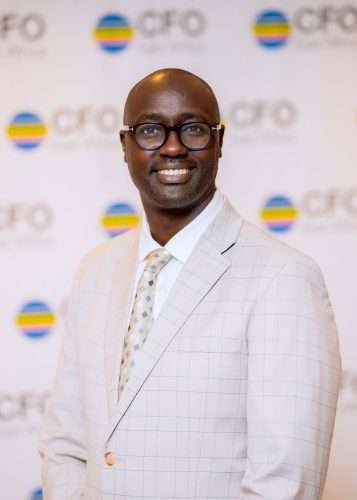
After nearly four years as the head of finance at Qona Sacco, Eric Shikanda has stepped into the COO role at The Kenya Bankers DT Sacco.
Eric Shikanda speaks to CFO East Africa about why he is keen to prepare the organisation for a workforce shaped by tech-driven change.
You’ve moved from managing finance to overseeing operations across the organisation. What mindset shifts or leadership adjustments have been most critical for you in stepping from CFO to COO?
One of the most profound realisations is that when one moves from being in charge of a department to being in charge of the organisation, they must desist from acting as head of department and transition to being in charge of the whole organisation.
For more than 15 years, I have been in the finance field. From accounting, audit, tax and high-level finance, my career has largely oscillated within the finance industry. It is therefore a default leaning towards a finance mindset. One of the critical mindset shifts is to move from a purely finance view of the organisation to the overall view of the organisation.
I have had to intentionally focus on other departments as opposed to bettering the finance section, this has been done by looking at the whole chain of the process from onboarding a member to exit of the member.
Given your finance background, how are you integrating financial discipline into operational decision-making to drive efficiency and growth?
A casual look at those at the helm of saccos shows that the majority are finance professionals. The same, though on a smaller scale, is replicated in the wider financial industry. What finance personnel do not really appreciate is the potential impact of their industry in enhancing efficiency and growth of an organisation. Finance generally thrives on clear structures; it is a highly formal industry that views situations from a return on investments lens. From the ROI and ROA lenses, efficiency in resource allocation is the result and in extension growth.
Finance background ensures that I identify the drivers of growth in the organisation and therefore influence the allocation of resources to the real drivers of growth.
You have led digital transformation and business process reengineering initiatives that significantly improved efficiency. How do you plan to scale or evolve those transformation efforts in your new role?
In my working life as a finance professional, I was privileged at some point in time to work in the most digital sacco in Kenya. The sacco was highly digital so that you did not have to physically report to the office but work from whichever location. It is from that background that I intend to influence digitisation in my current role. One of the areas to begin is to clearly document all the processes in the organisation, evaluate the relevance of each of those processes. Once this is done, we then check the requirements that would be essential in digitising that process, we look at the personnel, the system and customer among others.
Now that you lead cross-functional teams, how are you approaching staff supervision and development to ensure collaboration and accountability across departments?
Staff supervision is not new to me; I have been a supervisor of staff for more than 10 years albeit on a smaller scale. Moreover, as the head of finance, I was the second to the CEO and would step in whenever the CEO was out of the office.
One of the tasks was overall staff supervision and ensuring that the whole organisation’s staffing issues are taken care of in liaison with the head of HR. This experience made it easy to now step in fully as the COO.
My approach as the COO has been to build capacity in my direct reports, managers, to ensure that they are well equipped, well motivated and well trained to supervise staff in their departments. Currently, on a weekly basis, I hold one-to-one meetings with the managers to get appraised on the happenings at the department.
As COO, you’re responsible for operational risk. How are you balancing innovation and efficiency with risk management and regulatory expectations?
Balancing innovation and risk is a really interesting arena. The good thing is that these aspects are widely emphasised in finance. Risk management and regulatory compliance are usually at the heart of the finance responsibilities. Mostly, the teams and individuals pushing innovation do not really have the risk aspect in their mind and, on the other hand, the team pushing risk management rarely think of innovation as they tread too carefully to venture into the innovation arena.
As the COO, one of the first tasks was to have a sit-down with the risk manager to understand her approach on risk management in the organisation. I have already initiated the innovation approach in which all the innovation ideas have to have a write-up on the risk aspects and regulatory aspects of the innovation. One of the other measures is to ensure that there is proper training to be done to all the staff on the importance of risk and regulatory requirements in innovation.
What operational priorities or strategic shifts do you expect will have the biggest impact on the organisation’s performance in the coming year?
The organisation will undergo business process reengineering to review and revise how work is done, identifying inefficiencies and closing gaps. At the same time, the growing presence of Gen Z and younger employees in the workforce will influence thinking and drive changes in workplace culture and operations. Digitisation will continue to reshape internal workflows and transform how clients engage with the organisation, while artificial intelligence will impact every aspect of work, from strategic decisions to day-to-day operations.