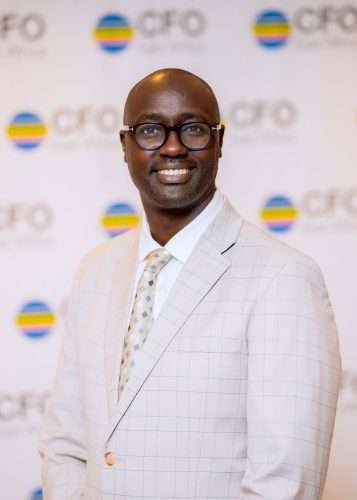
At least once in a lifetime, leaders encounter lessons that shift how they lead. PostBank Uganda CFO Peter Ssenyange, Vodacom Tanzania FD Hilda Bujiku, and Silverback Tea CFO Rahul Bedi reflect on the moments that forced them to rethink what it means to be a leader.
When Peter Ssenyange joined PostBank Uganda as CFO, team morale was low. Although he describes his team members as highly competent, the entire organisation needed an overhaul. In his eyes, the bank was a startup hidden in the shell of an old institution.
“I told them the losing stops today. The change started with me and I told them this is what I am doing to change. And these are my weak points, and I’m hoping that you can help me improve them. And this is how I’m going to hold you accountable,” he says.
Even within the bank, Peter had to work hard to sell his vision. He began by raising the team’s skill level and setting clear standards of performance. But changing the organisation’s culture required him to undergo a transformation of his own.
“When you’re leading people you reach a point where you’re not leading people anymore. You’re leading leaders who then lead the people. So that was important. You know, I think the one area where I’ve grown the most is on the empathy side.You need that to perform because you’re dealing with people,” he says.
Peter’s efforts have seen the bank assume Tier‑1 status and win several awards. The bank, which is set to rebrand to Pearl Bank, has also launched new digital platforms and overhauled its operations.
“I usually say that we were dealing with a startup because the bank has been around for a long time, but it’s like having hardware, then you redo all the software. On top, it still looks the same, but the way it runs inside is completely different. So that’s why I call it a startup. When we put out a job now, people are scrambling to come and join,” he reveals.
Silencing the inner critic
Vodacom Tanzania FD Hilda Bujiku knows this lesson all too well. Earlier in her career, she battled an inner critic that made her choose silence whenever she had the urge to speak up. She was often trusted to deliver on high-stakes assignments and was commended for her success. In 2016, for instance, she relocated to Lesotho to help resolve an internal controls issue that had been flagged by the board. But she still struggled with self-doubt.
“I always had a voice in me that said, ‘You’re not enough, you’re not supposed to be here.’ So whenever I did something well, I didn’t feel accomplished. But I feel like now the bar is raised. Now I need to do more,” she says.
With time, she came to see that leadership demanded the confidence to take up space. She began to cultivate presence and talk back to her internal critic. As the telco’s first female and Tanzanian finance director, Hilda considers her career trajectory a triumph in her battle with self-doubt. She now speaks openly with her team about those inner voices.
Hilda sees finance leaders as business partners rather than spectators. For this reason, she encourages her team members to take up space.When they do not speak up in meetings, she helps them reflect and pinpoint the moment when their internal critic took over.
“I will say, ‘I saw you were trying to say something and you didn’t. Was it because you thought it was not relevant or you were not sure?’ Then we will unpack it, and sometimes, you realise it was the inner critic speaking louder than reason,” she says.
The cost of burnout
In the same vein, Silverback Tea CFO Rahul Bedi has had to rethink what high performance looks like. For years, he worked long hours and measured himself by the results he delivered.
“If there was work, I would just sit and finish it. It didn’t matter when I was finishing, it didn’t matter when I was leaving the office. And I was doing it happily. But over a period of time I realised that you have to balance and you have to prioritise,” he says.
But the loss of his father in 2023 shifted his priorities. That same year, he began a fitness journey and changed his relationship with work. Nowadays, Rahul no longer lets urgency dictate his schedule. Instead, he has set out to design systems that make it possible for him to recognise when he needs to reset. He also encourages his team to think long term and avoid burnout by learning how to manage their energy.
“See every time, people like us, we look for small wins here and there. So if some wins are coming from your personal life and other wins are coming from your professional life, it gives you a very positive environment. It helps you feel balanced and focused,” he says.