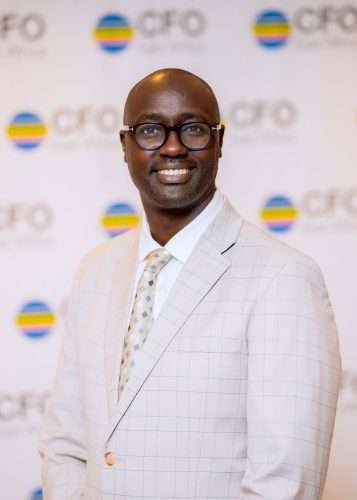
Post-harvest food loss drains billions of shillings from the agricultural economy every year. Newton Matope, CEO of Cold Solutions Kenya, explains how an unbroken cold chain brings predictability to the region's volatile logistics networks, and why he views regulatory hurdles as an invitation to design better infrastructure.
Newton Matope, CEO of Cold Solutions Kenya, describes himself as a builder. It is a quality that applies to his professional work in food security and supply chains, but also to the way he lives his life. Having visited more than 55 countries, he draws on a deep store of global perspective when thinking about markets and clients. As Newton sees it, success that is not coupled with a deliberate effort to give back to the communities where a business operates is hollow.
“I get a tremendous amount of energy from seeing the synergy between our company and our partners when we align on a vision and the results follow. The true engine of success is our team. To look around and see a group of professionals who are genuinely engaged, intellectually curious and committed to our mission is what makes work sustainable and enjoyable. Success is a team sport and it is the collective win that keeps me motivated,” he says.
Cold Solutions Kenya operates a temperature-controlled cold chain facility out of Tatu City in Kiambu County. The core problem the business addresses is post-harvest loss, a drain on Kenya's agricultural economy that runs into billions of shillings annually. By providing an unbroken cold chain, the company reduces food loss in transit and brings predictability to supply chains that have historically been volatile. Just 12 months in, Newton says the company is on track and that every challenge along the way has been treated as an invitation to improve.
“The past year has been about proving our model and building momentum. My most memorable experiences have been the milestone moments where we hit our growth targets and where I promised the team we would celebrate that success together. I found that there are no bad moments. It is only lessons that you get. In the cold chain sector, you have to be very adaptive and view every hurdle as an opportunity to design better and provide a better service,” he says.
Solutions, not storage
The difference between what an agribusiness needs and what a pharmaceutical company needs illustrates the point clearly. For an agribusiness, the design priority is volume and rapid turnover to reduce post-harvest loss. But for a pharmaceutical client, the focus shifts entirely to rigorous security and compliance tracking.
“Cold chain is just keeping things cold, right? But that is a very dangerous misconception. The reality is that the regulatory framework dictates the entire infrastructure design. An export-oriented logistics operation requires a different layer of digital integration. IoT-enabled visibility and real-time data flow are non-negotiable. Ultimately, what I think about is the operational blueprint. Each sector requires a fundamentally different architecture of technology, security, and human expertise,” he says.

According to Newton, the company’s success today is measured by how well it has customised its solutions to help partners unlock growth and reduce waste in their specific operating environments. The technology underpinning this approach is a combination of warehouse management systems, IoT sensors and GPS tracking across the delivery fleet. Clients can log in and view stock movement in real time, run their own reports and monitor what is happening to their goods at any point in the chain.
In transit, the system tracks vehicle location, temperature profile, door status and route optimisation simultaneously. Newton frames this as a direct response to the fear of losing visibility when goods leave a client’s facility. Cold Solutions is also implementing last-mile technology that allows customers to sign for deliveries digitally, with documentation transmitted automatically to all relevant parties.
“One of the biggest concerns for any client is what they perceive as a loss of visibility, loss of control and loss of certainty. Where you give custody of your goods to a third party, it creates an element of uncertainty which becomes a risk. What we are trying to do through IoT is empower the client to have that visibility at their fingertips. You are completing the cycle and at the same time creating that assurance that the cold chain has been maintained from end to end,” he says.
Strategic location
Cold Solutions' presence in Tatu City is also not incidental. Newton describes it as a deliberate strategic choice that functions as an engine for client success. Operating within Tatu, a special economic zone, gives clients access to tax benefits, helping to reduce operating costs and improve supply chain efficiency in addition to direct proximity to major transit corridors. For clients who are importing in bulk and re-exporting across the region, the elimination of double taxation and the reduction in transit times are huge advantages. Newton sees Cold Solutions as a route-to-market enabler for the wider East African community.
“We are engineering a leaner, faster and more cost-effective supply chain solution for companies looking to operate across the African market. We provide fiscal efficiency through tax deferrals and duty exemptions, geographical efficiency through direct access to major transit corridors and operational efficiency through our facility design. As much as we are located in Kenya, our focus is on the greater East African community,” he says.
In Newton’s view, Kenya has the ingredients to become a definitive cold chain hub for East Africa, but three things need to change for that potential to be realised. The first is policy consistency.
“We need a harmonised, 'single-window' regulatory environment that simplifies permits and licences, making it easy for investors to operate across county and national lines. For example, a truck moving from Nairobi to Kisumu currently passes through three or four counties and requires a separate permit in each, covering access, licensing and branding. For a third-party logistics provider managing a fleet across multiple routes, that fragmentation is a serious operational constraint,” he explains.

The second priority is the commercialisation of the railway sector, which Newton believes could create a high-speed cold corridor linking inland agricultural hubs to export markets if run on a demand-driven commercial basis. The third is a new model of public-private partnership in which the government derisks foundational infrastructure investment and the private sector brings capital and technical expertise to scale.
“When regulation is predictable, capital moves faster. If we bridge the gap and move away from the current fragmentation of the value chain, we will not just be a logistics player. We will be the engine room for food security and export growth for the entire region. I am quite optimistic because I see the appetite for this evolution coming through every day in our relationships,” he says.
Paying it forward
For Newton, the team is everything. As he sees it, if you get the people aspect right, everything else becomes significantly easier.
“Mentorship has been the bedrock of my own career; I am where I am today because of leaders who invested in my potential. Naturally, that responsibility to grow talent for the present and the future has become part of my DNA as a CEO. My approach to leadership is the antithesis of a 'CEO-centric' organisation. I don't want decisions to revolve solely around me; I want them to happen at the front lines, where our team’s deep technical expertise and local knowledge can have the most immediate impact,” he explains.
That same appreciation for precision and teamwork carries over to Newton's downtime, as he is a dedicated follower of Formula 1 and a passionate supporter of Arsenal FC. But the things that truly ground him are his faith, family and friends.
“I also make it a priority to engage in philanthropic work focused on supporting the vulnerable in our community. I’ve found that serving others gives you a perspective that business metrics simply can’t provide. It keeps me humble and focused. Ultimately, it reminds me that our work as leaders must serve the greater good, and that is the larger purpose driving everything we do at Cold Solutions,” he says.