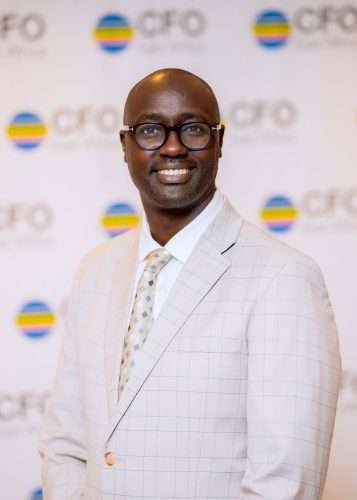
Tom Macharia believes the best lessons come from pain you choose to learn from. The head of finance at Amadeus East Africa is now building a life away from the place he called home for 26 years.
Amadeus East Africa head of finance Tom Macharia has been laid off twice in his career, and he considers both occasions among the best things that ever happened to him. The first time changed how he thought about loyalty to any company.
"The second one did not hit as hard as the first. In fact, it was mostly fine. Then you wake up and realise you can be laid off at any time. Those lows were highs because they allowed me to manage things in difficult environments. Everything could be on fire or a million things could be going on, but at any point in time, I want to believe that everyone knows that I am stable. They can come to me and I'm able to think through things and stop and say, we need to do this and this. I'm hardly ever going to lose my cool just because the house is on fire," he says.
He arrived in Kenya just weeks before the country shut down for Covid, after 26 years in the United States, where he had built a career in finance across retail, energy, think tanks, and technology. For 15 years, he tried to get a job back home, meeting with executives whenever he visited and sending applications. Then a woman he had worked with on a project in Boston three years earlier remembered a conversation they had once had about wanting to work in Africa.
"She was leading the project, and as we were wrapping up. She asked me, are you from Africa? I told her I was from Kenya, and I'd love to work in Africa one day. And her skills and the things she builds are incredible. So, I told her, if you ever go to Africa to lead things there, let me know. I'll follow you," he explains.
Invisible infrastructure
Tom describes American society as liability driven, a system designed to trap you in debt from the moment you set foot on a university campus. By the time one is 55, they have a family with roots laid down and no realistic way to extract themselves. While he lived in the US, Tom watched his father die back home in Kenya while his mother struggled alone.
"If you sell your house, you come back here with say 50,000 dollars. 50,000 in Kenya will not last you six months. Then what? And most people think, then what?" he says.
Amadeus is part of the invisible infrastructure of global travel. When searching for flights from Nairobi to London, the system that presents routes, times, carriers, and prices is likely powered by Amadeus. The company holds over 50 per cent market share globally. Tom manages the finance operations from a fourth-floor office at 14 Riverside Drive, the site of a terrorist attack in 2019 that left his predecessor injured and the company's staff held hostage for 15 hours.
"I arrived here in March 2020, and a few weeks later, we were shut down. In fact, when I was flying in, there were countable people in the Dubai airport who had some masks on. So I come in, it's chaotic, and then Covid hits. And then we are told we all have to work from home," he says.
Tom's wife and children still live in the United States. Although they usually visit in the summer, they are starting to think more seriously about moving.
"The current administration has made Kenya the better choice. So we are thinking about passive income, about rental properties and stable stocks, about building a base that will support us when we can no longer work. I am fifty. I do not want to be the parent calling my children for money," he reveals.
The difference between right and wrong
He raised his children without corporal punishment, encouraging them to contemplate their own actions instead. His middle daughter would often feel visibly disappointed at the knowledge she had let him down. For him, it is more important to teach his children to internalise right from wrong rather than simply respond to the threat of punishment.
"I call up my son, or any of my two wonderful daughters, and I'll say I have this problem, I've been trying to think of a solution. Please help me think through it. They will see the value in themselves. And you can even tell them, don't think about it now. Just tell me tomorrow or next week. But please help me with a decision. And then when they give you the decision, use it and show them that you used their suggestion," he says.
As a finance leader in the travel tech industry, Tom worries about artificial intelligence. He has begun to think about the ways in which human judgement will still matter even after machines learn to process transactions and replicate tasks in nanoseconds. The younger generation, Tom believes, is taking AI classes outside college because institutions are teaching obsolete skills.
"We can be lazy and decide we will just sit it out and continue doing our own thing, or we can learn where this AI thing is going, and find out how to position yourself for where you want to go," he explains.
On Saturdays Tom often rides his motorcycle from Nanyuki back to Nairobi through Muranga, stopping to talk with strangers and children who want to see the bike. Sometimes, he rides up to Samburu. There on the open road, with the wind in his face, Tom feels at home.
"A lot of people, when they think of people who ride, it's been those guys who lean on the bike doing wheelies and stuff. But most of the people I ride with, they're professionals. Finance, people, doctors, lawyers, more mature in age. They're not racing. We're just going to see some place. You know, we have conversations. We sit down in the evening, light a fire, talk and go back home," he says.