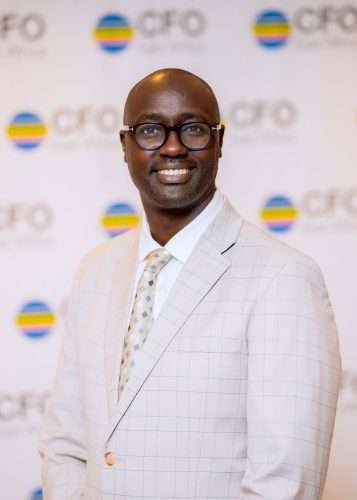
A formative conversation with his father set Jambojet cfo Ira Kaviti on a path that changed how he thinks about purpose and leadership. He now applies the lessons he learned about trust during a stint in Bermuda to his work at the airline, where he is focused on keeping costs tight and making clear, practical decisions.
In 2004, Ira Kaviti's father sat him down for a conversation he was not prepared for. He was three years into his career at Deloitte and was progressing steadily. But his father did not believe progress meant fulfilment.
"He said: something is off with you. From the outside, you look like you're doing very well, and indeed, society thinks that you are doing well, but you've somehow not found yourself. You do not have time for yourself. You work a lot, work very long hours, and when you are outside work, you're always with your friends, and so you never have time to think, you never have time to reflect," Ira says.
Although his first instinct was to push back, he sat with his father’s words, and when he began mapping what he had wanted to achieve since primary school, he found that many of his goals remained unchecked. Ira realised that something had to change and went into a journey of soul searching. After that, he passed his final CPA papers, noticing that feedback from his managers was improving. Then a cold call came from a Scottish recruiter placing auditors across the UK, the Cayman Islands, Canada and the United States.
“There were certain things that I had set out to achieve but had not yet done. One of them was, it was always one of my goals to work outside Kenya, outside Africa particularly, gain some experience and come back," he says.
When the recruiter asked where he wanted to go, Ira said Bermuda. She laughed and asked whether he was sure he wanted to work in a remote island where most people were on holiday while he was working. That was how he ended up at EY (then Ernst and Young) in Bermuda.
"I later on consulted for a small firm called Frontier and ended up working with the Auditor General of Bermuda at some point for six months. She is one of the most impactful leaders that I have worked with. That lady would get negative feedback from parliament, sit at her desk and write an email sharing any negative feedback she had been given by the Bermudian Parliament about the quality of her and the team’s work. She taught me what it meant to be vulnerable and transparent with people that report to you," he says.
The gift of Bermuda
After two years at EY and later Frontier, Ira joined the Bermuda Monetary Authority, the island's financial regulator, for a year and a half. It was 2008, and the global financial crisis was unfolding. Bermuda, as a jurisdiction with the world's largest reinsurance companies registered within it, sat at the centre of much of what was happening.
"During that time, there were very interesting meetings, like when one of the largest insurance companies in the World was being broken up and some of its SPVs were being closed down. I ended up sitting in some of those meetings with regulators from Bermuda, sometimes including regulators from the UK, Ireland and the US. It gave me a lot of confidence, that I could find a voice in such discussions" he says.
Ira had previously found insurance complex and intimidating. Having seen it operate at a global scale, the Kenyan market suddenly looked less challenging to him. When he returned home and interviewed for a head of audit role at an insurance group, he found he could hold his own in conversations he would previously have found daunting.
"I quickly realised that there are certain skill sets that I and some of my colleagues that come from Africa had that maybe back home were not appreciated. But out there, people appreciated those skills. That helped me in making the decision for the next career move," he says.
The leader who saw him first
Long before his stint in Bermuda, Ira was a new graduate at Deloitte, where he met a manager who later became CEO of a large company now listed on the NSE. At the time, he was not sure of what he wanted from his career. Three months into his time at Deloitte, an offer arrived from an agency paying Ksh 2000 more than he was earning, and he promptly wrote a resignation letter.
"The manager looked at my resignation letter and said, I have assessed your personality. I understand you, and you are not the kind of person that can survive there. I asked him why he thought that was the case. He told me, your values will not align with that organisation’s values," Ira says.
He kept the letter in his desk drawer and told Ira he had three months to change his mind and come back. Ira went to the organisation for orientation on a Friday. During the session, the HR director pulled him aside and asked which senior person in the agency had help him secure the job offer.
"That question took me back to Deloitte on Monday. I very quickly contextualised and understood the conversation with my manager in Deloitte. I eventually figured what I valued most, and realised that trust is my currency, without which I would have very little to offer," he says.
In 2022, Ira joined Jambojet as CFO, the airline was still working through the wreckage of Covid19 and immediately set out to craft a financial strategy to fund recovery and growth. Through negotiations with parent company KQ, aircraft lessors and banking partners, the airline worked its way back to stability and growth in market share.
“We are still implementing the staged financing plan for the business developed in 2022 and have already completed several stages. Our corporate headquarters had previously been an archive building. We took immense pride in showing it to our bankers, most of whom understood that modesty represents the ethos of a frugal, low-cost carrier airline. We have seen that understanding translate into solid backing and funding of our expansion" he says.
Although he considers himself new to the CFO role, Ira says his key focus has been on value creation and financial transformation. He is also keen to build a resilient balance sheet and manage risk.
“Low cost carrier airlines have to treat every cost line into a potential strategic advantage. For example, how much does an extra minute in flight time between destinations cost the airline in fuel burn and staff productivity pay? Tone from the top is also quite important. The office of the CFO of a low-cost carrier must lead from the front in managing costs," he says.
Building a team that delivers impact immediately has been one of his preoccupations. Initially, Ira spent late nights in the office with the team to demonstrate to them that he would never ask them to do something he was not willing to do himself. He realised that he had succeeded in his mission when the team found its own rhythm and balance and no longer needed to spend late nights in the office.
"I've had people coming in from the university, and they are processing payments in their first few weeks. I always considered it critical to expose even the most junior of team members to the office of the CEO. The intention behind it is to quickly build confidence and self-belief in the team. Deloitte certainly did that for me " he says.
An abstract thinker
Ira’s tastes in art and music are eclectic. He believes the Parliamentary Honours Committee should closely look at the work of one of his favourite artists, Ayub Ogada, the musician whose work featured in the Academy Award-winning Out of Africa. As a child, he dreamed of being an architect or a cartoonist. Earlier on, he would have been very happy to just be a bus driver. He still draws and paints, saying his career coach keeps telling him to go back to it, as it is the place he truly calls home.
"If you ask me who I am really deep inside, I am somebody who prefers to chase causes higher than myself, to inspire other people to action. I was always like that from primary school, tiny, but always thinking, thinking of ways to get people to accept or agree, to rally people across a course of action," he says.
He describes his thinking as essentially abstract, a process he has come to understand as the first stage of how he works through difficult problems and finds solutions.
"I realise I am part of a team that is leading a company that has quietly become systemically important to the economy of this country and the region. The knowledge that many stakeholders rely on this company shows the immense responsibility we hold to maintain trust and consistent value " he says.