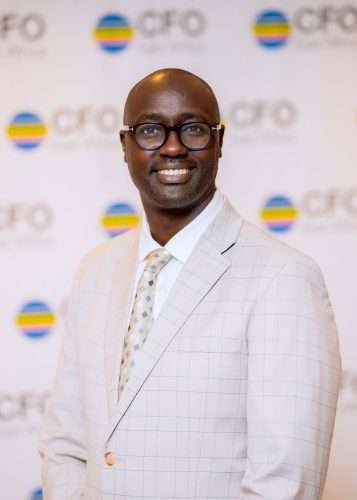
When Dennis Musau, chief finance and value officer at Stanbic Bank, took up the position in 2022, the organisation had already expanded the role, elevating the CFO from chief accounting officer to the CEO’s thinking partner. At the recent CFO East Africa Summit in Nairobi, Dennis offered his insights on transitioning the role of the CFO to include a value management perspective.
According to Dennis, the traditional CFO holds the mirror to the organisation, reflecting on the past, the present and the future. The past reflects trends and performance history, while the present tracks every-day actions and metrics such as margins and prices. The future, which includes forecasts, planning, and budgeting, maps out the trajectory of the world.
The CFO typically also acts as chief business partner to the CEO, helping them manage all aspects of the organisation, including investments and capital deployment. As the chief accounting officer, the CFO also manages the organisation’s ledger, booking debits and the credits, and costing the team.
But in 2019, Stanbic Bank began to transition the CFO to what Dennis terms a choir conductor, including tasks formerly performed by the phased-out chief strategy officer.
“In fact, the way our group organisational structure is drawn up is, on the one side you have the manufacturers, who are the guys who manufacture the various banking products. On the other side, you have the distributors. These are the market facing units, and segmenting the business into various sub parts, then you have the CEO and the CFVO on the side, holding joint accountability as to the delivery of that strategy. So that's one dynamic that was introduced by the role,” he said.
This reimagining of the CFO role demands that the CFVO act as global strategist, supporting opportunities and challenges and charting ways to navigate them. Dennis revealed that this placed responsibilities on the CFO’s scorecard for which they may not have been directly accountable before the transition, such as return on equity (ROE). A global survey of nearly 600 CFOs by consulting firm Egon Zehnder found that 82 percent said their role had grown to include new responsibilities in the past five years.
“Now, I know I'm singing to the choir because for most of you, ROE is part of your scorecard. But in the past that wasn't. We just reported and we said this is what the mirror kind of says. Long-term value becomes very essential, helping the organisation navigate the short termism of investors and the long termism of communities and society,” he said.
Keeping organisations competitive
Unlike the previous dispensation, where CFOs ran budgets through a tool to determine return on investment (ROI) and generated an internal rate of return (IRR), they must now originate ideas to keep their organisations competitive. Surrendering one’s independence, Dennis noted, could bring about the death of the business.
Recalling a conversation he had with the group CFO of Stanbic Bank before he took up his current role, Dennis advised traditional CFOs transitioning into the CFVO role to gain a mastery of the fundamentals of finance.
“The CFVO must intimately understand business. I heard that from Peter Ndegwa, CEO Safaricom when he spoke to us at the launch [of CFO East Africa in October 2023], almost indicating that he looks to the CFO to sense-check whether they are doing the right thing. You want to test whether the organisation is doing the right thing, in investments, in markets, in market share gaining and in new attack strategies,” he said.
Dennis also highlighted the possibility that the CFVO might be called upon to influence people higher up in the organisation and play a key role in negotiations. He advised transitioning CFOs to expand the scope of their thinking, addressing their minds to matters such as risk, compliance, investment, and real estate. He called upon them to act with the future in mind, saying the evolution of the role was inevitable.
“The expectation of CFOs today is that they have a comprehensive understanding of how the organisation operates —from start to finish, across all functions—markets, distribution channels, last-mile operations, and more. You're expected to influence the organisation's strategy with this knowledge. This presents a significant challenge as we look to quickly gain that understanding while also managing and balancing the demands of various stakeholders,” he said.