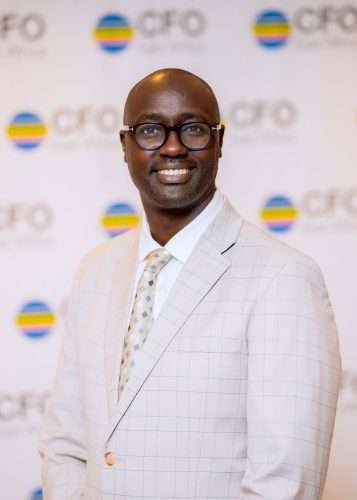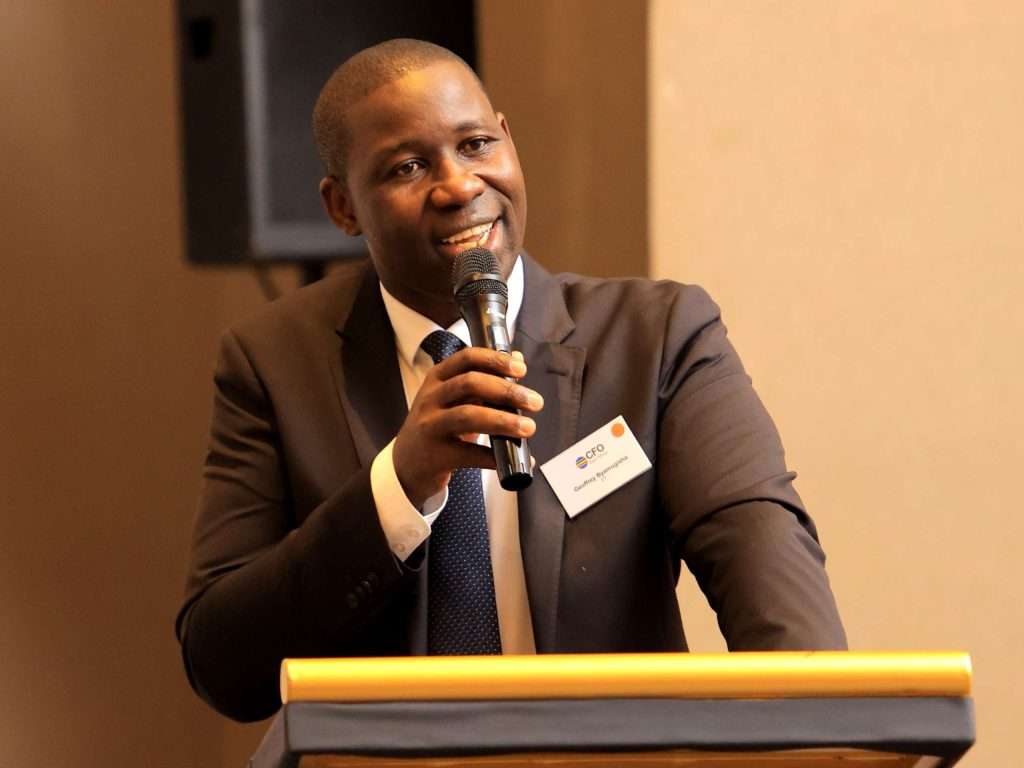
CFOs must evolve beyond the traditional focus on financial oversight to remain relevant in a rapidly changing world. This was the take-home from EY Uganda managing partner Geoffrey Byamugisha’s address at the CFO Summit: Reflections and Aspirations at the Four Points by Sheraton in Kampala.
For the second year running, EY Uganda managing partner Geoffrey Byamugisha delivered the partner address at the CFO Summit in Kampala, during which he emphasised the need for finance leaders to transcend technical skills and financial performance. He advised them to anticipate future needs instead and embrace digital transformation as they prepare their teams to meet the challenges of the future.
“When you sit with boards, they talk of future requirements. Others even go further and say, ‘Do you have somebody from your workforce whom you can recommend? Do you think our CFO has the right skills and experience to transform our organisation and meet our future strategy?’ These are not easy questions, but they are the ones we need to answer to remain relevant and impactful as finance leaders,” he said.
As Geoffrey stated, the role of the CFO required finance executives to adopt a forward-looking mindset that keeps their organisations resilient. He urged them to develop a deep understanding of both financial and non-financial metrics and hone their ability to influence decisions at the highest levels of leadership.
He also addressed the impact of recent geopolitical developments, including the US presidential directive imposing a 10 percent tariff on all imports, on business strategy. He noted that this and other macroeconomic changes had increased uncertainty in the global business landscape, encouraging CFOs to anticipate their effects.
“What is happening in the Middle East? What is happening when Europe says they are now beefing up their security and all that? What does that mean for our economy and our businesses?” he said.
In Geoffrey’s experience, finance leaders often struggle to keep up with advancements in AI and digitisation, which are being integrated into business operations. He advised them to align innovation with the objectives of the business to keep their organisations competitive.
“Do we have the right AI and digital strategy that aligns with our overall business objectives? And quite often we don’t actually know how either AI plays in our organisations, or what they mean by digital strategy. How is the organisation navigating compliance challenges and regulatory demands? The regulators are coming up with new needs every day,” he said.
Growth in a changing landscape
Drawing from his own experience at EY, Geoffrey revealed that an attempt to restructure had served as a valuable learning experience that informed the firm’s current strategy.
“When we failed, we said, ‘When you fail, you take the lesson’. Our strategy is an ‘all-in’ strategy, where we create new value for the EY people, for the clients and for our stakeholders,” he explained.
In Geoffrey’s view, CFOs must build relationships with clients and stakeholders to keep their organisations successful in the long term. To this end, he encouraged continuous learning saying finance leaders needed to adapt to the changing expectations placed on them and develop skills that go beyond traditional financial management.
These include strategic thinking, digital literacy and stakeholder management. Further, he advised CFOs to play a part in defining their organisations’ digital strategies, saying clarity and focus were needed to succeed in an era of technological change.
“You are our gateways to your organisations. It is important that we work with you and connect with you, because those relationships, I’m sure, will make more relationships. You cannot afford to be reactive. You must anticipate change and prepare your teams accordingly,” he said.
As Geoffrey noted, CFOs shape the future of their organisations, requiring them to be strategic advisors to their CEOs and boards. He also recommended training and upskilling their teams, saying an agile finance function would be the key to navigating the challenges presented by the current business environment.
Building on the question of how to navigate the CFO-CEO transition, Geoffrey identified trust and integrity as vital leadership qualities. He advised finance executives to lead with courage and conviction, keeping the people they work with at the fore.
"Should we consider setting specific workforce objectives for the CEO and other C-suite executives? In other words, they are saying, can we make talent management a key performance indicator for executive compensation?” he said.