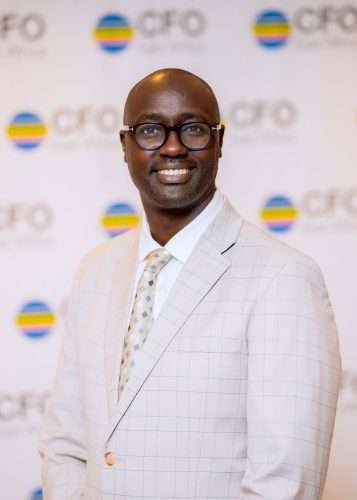
Stephen has learnt to see the people and strategy behind every figure. He has come to see the role as one of understanding what the numbers mean and what they make possible.
Umoja Microfinance CFO Stephen Okoth sees numbers as only the beginning of the finance conversation. He challenges the old approach in which finance teams simply tell other departments what they can and cannot spend.
“Back in the day, finance people used to dwell so much on numbers saying, this is the budget, this is what we’ve achieved and we can’t go beyond this. Nowadays, in my interactions with other CFOs, we talk about value. A CFO is a value-addition position in an organisation. In modern finance, you don’t just talk about numbers or restrict operations teams to arbitrary limits,” he notes.
His approach is to understand the relationship between spending and results before making a decision. A higher expense does not automatically mean something is wrong if it is supporting stronger performance.
“Right now, we are exceeding our budget in terms of costs, both G&A and personnel. But I can’t just tell the HR team to stop recruiting because we have exceeded the HR budget or tell the operations team to stop opening branches because our rent or G&A exceeded budget. As a finance person, you have to analyse why we exceeded the budget and what that exceeding means in terms of impact,” he says.
Grounded in the field
Because of where his career began, Stephen can connect financial information to what happens outside the boardroom. His 19-year career has been steeped in financial inclusion, beginning at Kenya Women Finance Trust as an accounts clerk in Bungoma.
“I remember I started on 5 March 2007. I reported at the branch and I was the first accounts person that branch ever had. I was fresh from a classroom and had to figure out what to put in place just to help control things including petty cash management, stock control for stationery, giving customer care feedback to my boss. It was an interesting one week,” he recalls.
Then, only two weeks after he arrived, an unexpected assignment took him out of the accounts desk. The experience changed how he understood the work.
“A colleague went on maternity leave, so I had to cover for her in the field riding a motorbike. That’s where I learnt how to ride a Yamaha DT175. I would ride out to meet women’s groups. I did that, covering for the lady, for three months and it changed my thinking. The meetings connected me with the women in the groups and their stories, and it developed a longing in me to go to the field once in a while even as an accounts clerk,” he recalls.
He later joined ASA International, where he ran the entire finance function. Those experiences gave him a view of finance that stretched beyond accounting and prepared him for his next major challenge.
Building from zero
When Stephen joined Umoja Fanisi as CFO in October 2022, the institution was just starting. His responsibilities extended into areas outside a CFO’s job description.
“I joined and did everything from scratch. I did the licence application from the Central Bank of Kenya, we are a regulated institution, and for that you have to define policies, put them in place and communicate with the regulator until you get the licence. That took about seven months,” he says.
The startup environment required him to become comfortable with responsibilities beyond finance. With the organisation still in its early stages, he also had to think about where the available limited resources should go.
“And apart from being CFO, you hold so many other titles in the background. You have to be the recruiter for senior positions, liaise with regulators on what needs to be in place, and figure out the system, we had a very new system. You also have to be like a compliance person because regulators want reporting done on time. So, it’s quite a different and inspiring experience that I’ve gotten as a startup CFO in Umoja Fanisi,” he says.
Today, Umoja Fanisi has grown to 66 branches, more than 480 staff and 73,000 women served.
Human judgement
Technology is now part of that growth at Umoja Fanisi. The organisation remains a traditional microfinance institution in its branch structure but its processes have become increasingly digital. Stephen believes technology should make work easier without removing the judgement that finance professionals bring.
“I don’t think there is a modern CFO that can just wish away AI. You can’t say you are better than modern technology. We do our reports and AI is there as an analytical assistant, but it is not there to replace human reasoning,” he notes.
However, Stephen believes AI does not eliminate the need for financial expertise. Technology can process information and provide analysis but it does not necessarily understand the circumstances behind a number.
“Interpretation of numbers requires understanding the story behind them, and every CFO knows there is always a story behind the numbers. So, AI may not give you the complete story, but as someone who meets with the operations people from the field up to head office, you are able to interpret those numbers so they make sense to the board,” he says.
Challenging the status quo
One of the people who influenced Stephen’s leadership the most was his manager at KWFT. She encouraged him to question established thinking rather than accept it automatically.
“The person I hung around a lot was my manager at KWFT called Perris Maina. She kept challenging me. She told me that as a supervisor, you are there to challenge the status quo, not to get comfortable with whatever is proposed. If you sit in a room as an executive where you are talking and everybody just says yes, understand that you have a problem. There’s something running under the table and you don’t know it. Don’t think people are just compliant, something is wrong,” he recalls.
When he negotiates for funding, he thinks about the person waiting for that money in a rural community.
“Up to where I am as a CFO, what I enjoy most is that when I sit somewhere negotiating for funding, I don’t just negotiate to get money into the institution. At the back of my mind, I have a woman down in Kehancha or Ogembo who is waiting for this money to change her life. Sitting somewhere to create an impact down in rural areas really motivates me,” he notes.
Even away from the office, Stephen finds satisfaction in making numbers useful to other people. He turns his professional skill into a form of community service.
“For me, it is a sort of charity still in the line of finance. I belong to a men’s self-help group that has been together since 2017. I provide pro bono services doing bookkeeping and preparing financial statements for them for over the last 10 years, helping them interpret figures and what they mean,” he says.