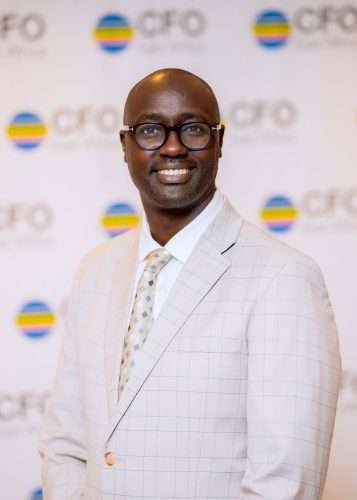
For Knight Frank Uganda head of finance Asibat Mwambu, it is always about results. The driven executive blends his deep sense of responsibility to his stakeholders with concern for the world outside the business, encouraging his peers to pursue their passion.
Asibat Mwambu’s move to Old Mutual in August 2015 was a game changer. At the time, he had nearly completed his sixth year as an auditor at EY and was ready for a new challenge. Although the firm had exposed him to nearly all aspects of a business, the insurance industry was entirely new to him.
“The learning curve was shorter because I knew the areas I needed to focus on so that I could get myself up to speed. And within a couple of weeks, I was up and running. Within three months, I was promoted to chief accountant,” he says.
Asibat’s role was expanded to include heading asset management, which was predominantly a loss-making business then. The company had even considered selling it. Although Old Mutual’s licence empowered the company to operate as a fund manager, unit trusts were not yet popular in Uganda. Asibat and his team therefore decided to shift focus to other business segments in their quest to return to profitability.
“There were a couple of companies that were about to get on the stock exchange, so we positioned ourselves to manage some of these IPOs. We arranged deals for a couple of clients and made some good money for the business at that time. And that shifted the dynamics. And it became an area that we gave focus going forward. Because as we are pushing the interest earning line, the commission earning line was picking up. And as we speak now, there’s more emphasis on this line,” he says.
To scale up its unit trusts business, the company, which had previously relied on its agents, began to provide training to anyone interested in being part of its sales force. With time, the
the assets under its management increased, and it gained more customers.
Sense of responsibility
“I must say, I’m proud of my three years at Old Mutual, which ended in 2018. By the time I left, it was profitable. I remember we made just under 1 billion Uganda shillings, and that's something I pride myself in,” he says.
Though he joined Knight Frank late in 2024, he proposed some key initiatives that resonated with the top management, a sign that he was aligned with what the business hoped to achieve. This results-orientated approach, honed during his days at EY, has become his career philosophy.
“People are interested in results. People are not interested in the stories. And I try to bring this into my teams. We have an objective. We can discuss the how, but let's meet the objective. And for me, in my experience at the audit firms, you can’t miss a deadline. So, focus on service. Delivery is important, coupled with quality. And for me, my experience in the audit firm shaped me, and it gave me that extra sense of responsibility that what you’re tasked with must be done by the end of the day,” he says.
Asibat’s entry into finance came purely by chance. Unlike most of his friends, he had missed the annual audit firm recruitment firm drive during his final semester as a statistics student at Makerere University. An EY advert piqued his curiosity, and he sent out an application. In the meantime, he joined an NGO and began to work as a statistician. After three months, he received a response from EY and was successful.
In his sixth year at EY, Asibat joined Berkeley Energy, where he managed several hydropower projects, contributing to the completion of four out of six projects during his tenure. His curiosity led him to Gold Star Insurance in November 2021, marking his entry into the C-suite and allowing him to bring to bear his broad experience from several sectors.
Although the pace of the industry is markedly different from what he was accustomed to at EY, Asibat’s focus remains the same: achieving results. The switch has allowed him to venture beyond the technical aspects of finance and hone his ability to manage stakeholders. He considers this critical, as he notes that the finance profession is changing.
Helping others grow
“Early in my career, it was more of understanding the role of a finance professional, and as you grow into the role, you realise that the role can be enriched. Half the organisations are not going to say explicitly that the role includes stakeholder management or strategy. But if you are to live with the changes of the industry globally, of the role of a CFO, then obviously you have to evolve. And for me, the last couple of years, my focus has been to push myself away from the numbers deliberately. With the support of the head of business, in this case, my CEO, it becomes easier,” he explains.
In turn, Asibat has also taken some of his former colleagues under his wing, offering them the mentorship that saw him through his pivot from statistics to finance. Over time, he has developed relationships with them, helping them grow in their careers and take on larger roles.
“They moved on to other companies at a higher level, and the feedback I keep getting gives me that sense of fulfillment and satisfaction. So, you cannot underscore the importance of mentorship. It’s really critical. If you’re looking at career progression, you need someone to walk with you. You can’t do it alone. But if you have the passion for something, do it. Research as much as you can, consult your peers, and you’ll be able to sail through,” he says.
Through his investment in others’ growth, Asibat is not only advancing individual careers but contributing to the development of more sustainable business practices. Part of his strategic focus going forward is the principles of ESG, which he believes should be of concern to all finance leaders.
“Have we embedded this within our processes? Are we able to identify areas that we can improve the environment internally? For example, if I am in manufacturing, I know that the discharge coming out of my processes is going to find its way into the environment. So how, how do I ensure that within my budgeting cycle I have a vote for restoration? The aspect of governance is also critical. That is basically the pillar. It is how you run your business. The ESG agenda helps you manage your risks, because if you have bad controls, you are presiding over a sinking ship,” he says.
Asibat’s uncompromising attitude is evident even on the football pitch, where he plays every Tuesday and Thursday. The sport offers a chance to clear his head, stay active, and connect with friends. It is a habit he has maintained since his student days and remains a steady part of his routine.
“Football has always been a way for me to decompress. It keeps me grounded and gives me a healthy outlet away from the numbers. I make time for it regularly, no matter how busy things get. It’s one of the ways I stay balanced,” he says.