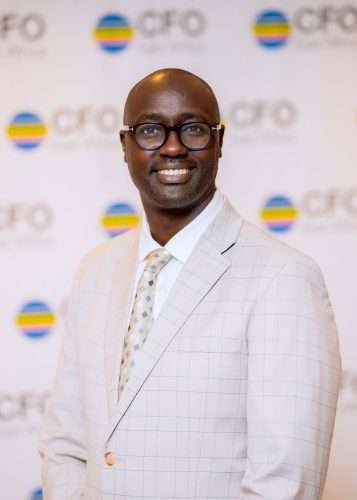
Bank of Kigali Group reported an 8.6 percent rise in net profit for the first half of 2025, driven by effective cost management across BK Group and lower funding costs. Head of finance Ange Ntiranyibagirwa says the focus now shifts to sustaining momentum through tighter execution and continued balance sheet strength.
BK Group opened the year with strong momentum, posting a net profit of 51.9 billion Rwandan francs and steady growth across its balance sheet. The bank kept funding costs down as loan volumes increased, helping to protect margins. Its operating income crossed 130 billion francs, while asset quality improved compared to last year. With the first half closed, head of finance Ange Ntiranyibagirwa signalled a sharper push on cost control and balance sheet strength as the group looks to sustain its pace.
“From 47.8 billion francs in the same period last year, this represents a growth of 8.6 percent year-on-year. So the total operating income achieved 131.6 billion in the first half of the year 2025, from 126.6 in the same period last year. This represents a growth of four percent year-on-year. This growth was mainly fuelled by net interest income, which grew from 91.8 billion to 103.0 billion, a growth of 12.2 percent year-on-year.,” he said.
Loan growth and reduced interest expense were key drivers in the first half. The group’s loan book increased by 231 billion francs, while term deposits were replaced with cheaper funding. This lowered the cost of funds from 3.4 percent in December 2024 to 3.1 percent in June 2025. Ange explained how these shifts helped contain pressure on net interest margin (NIM).
‘It shows we are actively managing our funding structure to remain efficient in a competitive market. We replaced expensive term deposits with more affordable sources, which helped us absorb pressure on interest margins. This kind of balance sheet discipline is what allows us to sustain growth without compromising profitability,” he explained.
Tough competition in the market forced the bank to give/waive fee concession in order to keep its competitiveness on the market.
“Non-funded income, which represents other bank business income that is also different from the interest expense, has decreased by 17.7 percent due to the fee concession. This resulted from the stiff competition on the market. Last year also we had a one-off fee which amounted to 2.5 billion. That explains the decline in non-funded income this year,” he said.
Strong value creation
Subsidiaries helped balance the group’s income profile. BK Insurance, BK Tech, and BK Capital contributed a combined 11.6 billion francs in operating income up from 10.3 billion over the same period last year. This marked a 13.5 percent increase year-on-year. According to Ange, subsidiaries keep supporting strong value creation for the shareholders.
In the first half, cost control remained a clear priority. Operating expenses were flat even with rising costs in the market. The group’s loan loss provisions dropped sharply, aided by improved credit quality.
“We are almost on par because of the continued effort to minimise cost while supporting the bottom line. This is also supported by the expected credit loss, which is the loss provision made on non-performing loans. It improved this year compared to last year by 28.6 percent and was driven mainly by the credit quality. That also reflected the reduced provision year on year,” he explained.
BK Group’s loan book continued to grow steadily in the first half, helping to keep risk levels under control. The bank also brought in more deposits, which supported overall balance sheet growth. These trends reflected careful lending and strong customer relationships.
“By the end of June 2025, the non-performing loan ratio stood at 3.25. The total asset of the group has grown by 4.9 percent, which was also driven by the loan growth. Loans grew by 15.7 on net basis and were financed mainly from deposit growth. Deposits grew by 5.9 percent year-on-year,” he said.
Strategic pillars
Despite a challenging environment, the group maintained strong returns. Ange pointed to stable performance and solid capital buffers that gave the bank room to keep lending and supporting growth.
“The return on assets stands at 4.1 percent in the first half of the year from 4 percent in 2024. Return on equity stands at 26 percent from 25.9 percent. The cost of funds improved from 3.4 in December 2024 to 3.1 in June 2025. That reflects improved funding efficiency,” he said.
He added: “Loan yield decreased from 14.7 to 13.8 year-on-year due to stiff competition pushing the bank to reduce interest rates. The cost of credit risk has improved from 2.4 in December 2024 and now stands at 1.4 percent. The bank is fully compliant with all liquidity ratios including LCR and NSFR. Both are well above the minimum regulatory requirement of 100 percent,” he said.
In the first half, BK Group delivered across key performance areas while absorbing fee pressure. Subsidiaries gave the group a broader income base. The focus in the second half will be on capital discipline, cost efficiency, and risk management.
“So the group is maintaining the focus on key strategic pillars, which is capital preservation, cost efficiency, and asset quality improvement. We are working on executing effectively on all the business lines to ensure that we close the year with a strong performance. That means optimising costs, driving revenue growth, and maintaining a prudent risk posture. All these are key to the performance expected in the second half,” Ange said.