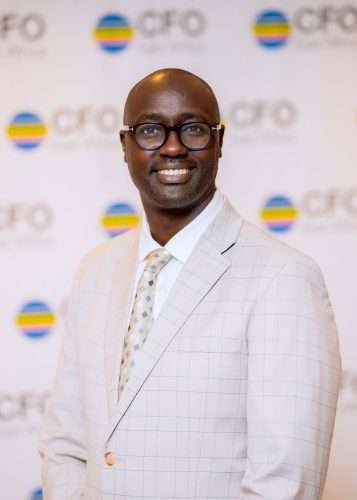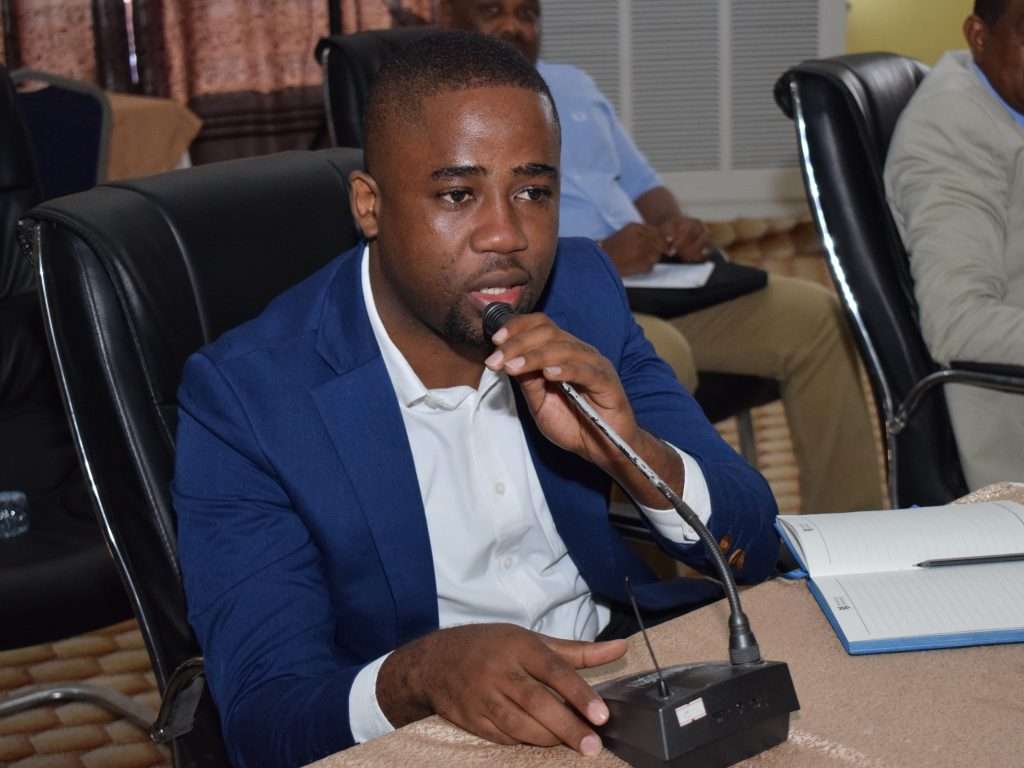
The first-time CFO considers himself a uniquely skilled finance professional who plays by the book but isn’t confined by it. He terms his recent appointment a “dream come true” and sees it as an opportunity to offer mentorship to rising finance professionals.
Becoming a CFO has been the highlight of Dolphin Professional Services finance lead Noel Ngonyani’s year. At some point, he remembers, his laptop password even had the acronym ‘CFO’ in it. For the last two or three years, stepping into C-suite leadership has been his singular goal. And while he is grateful for the journey that led him here, he is confident that his appointment was not a stroke of luck.
“I am not the type of finance professional who has been spoon-fed. I’m a practical guy, and while I play by the book, I have a mindset that goes beyond the books. If there's a problem, I will customise the solution based on what I need to achieve,” he said.
Looking ahead
Noel is now three weeks into his role at Dolphin Professional Services, where he manages a team of about 30 people. But he expects this to grow significantly, as the company is setting up across eight countries in East, Central, and Southern Africa. He already has an ambitious plan for the coming year, as he envisions the company taking up a strategic position as an ICT solutions provider.
“Looking ahead, my goal is to strengthen the financial capabilities of the company and contribute to its growth. want us to build strong financial muscle to make this expansion possible. Personally, I also want to invest in my development and mentor others,” he said.
One major challenge Noel reckons has held back the finance profession in Tanzania is a lack of mentorship. Although he was lucky to be mentored at the beginning of his career, he recalls having to walk much of the journey towards leadership alone. He learned by observing how other people worked and imitating it, applying his own skills. At Amana Bank, for instance, he advocated for himself to be appointed as an internal auditor, keenly aware of the necessity of auditing skills for a future CFO. For this reason, he is keen to mentor emerging finance professionals and impart what he has learned.
“In Tanzania, we are not trained to be leaders. We are trained to be operators. When I was new to the world of work, I had to learn most things by myself. It feels like survival of the fittest. If you're not good enough, you die off. If you're good enough, you climb the ladder,” he said.
Quiet bravado
When Noel was a child, he wanted to become an economist. Through observing his mother, who was an accountant, he was drawn to numbers, fascinated by the thought of studying money. At the University of Dar es Salaam, Noel’s mentor at that time, Celistine Onditi, suggested he pursue accounting instead of economics, and Noel obliged. Over his 12-year career, he has worked in different sectors, including a USAid funded project, agribusiness, hospitality, banking, construction, logistics, and financial services, drawing insights from each role. Now, he has his sights set on conquering the continent.
“For me, the key has been humility — being able to listen to others. Because in today’s world, there are two ways you learn. You learn by going to school, and by listening to your peers. That's the best way to get experience, they train you not to make the mistakes they made,” he explained.
Though unassuming, Noel displays a quiet bravado when he speaks about his achievements. He relates an experience he had two years into his career. When he was the country manager at Boston & Chance Tanzania, he was tasked with helping an investor set up a manufacturing project more than 200 kilometres away from Dar es Salaam. The investor had commissioned a feasibility study, but Noel had no experience in this area.
“I thought feasibility studies were for infrastructure projects like roads. I did not know about commercial feasibility studies. So, I learned about it on my own and came to understand that it was about profitability and cost structures. How are you going to deliver the product to the market and make more income from this product? So I built a model that attracted close to $5 million in investment,” he said.
This was the crowning moment of his time at Boston & Chance Tanzania.
A different approach
He however remains conscious of his missteps and is keen to learn from them. In the past, he often joined a company with his own mindset and proceeded without learning the people or the culture. This often threw him into conflict, forcing him to change his approach.
“Now, I listen to other people’s ideas and contributions. And it’s not that I was doing the wrong thing. I was doing the right thing, but the challenge was how to communicate my actions to other people. It’s important to consider other people’s input and so that they feel like they’re part of your process. A bottom-up approach, essentially,” he said.
Working in finance has also taught Noel the importance of setting boundaries. He describes it as “the kind of career where people can be suspicious of your intentions”. With time, he has learned to keep a professional distance to prevent people from misinterpreting his actions.
Although Noel looks back at his life with pride, he wishes he had begun to invest earlier in his career. Following in his mother’s footsteps, he is also a poultry farmer, an endeavour he is passionate about and expects will bear fruit. He cites the National Livestock Research Agenda 2020 – 2025, which shows that Tanzania’s national average annual per capita consumption is estimated at 75 eggs, which is far below the Food and Agriculture Organisation’s recommended 300 eggs per capita per annum.
“I remember when I was at the university one day, and we were having an event far from the main campus. So we were waiting for a shuttle to come to pick us up, and there was a conductor. He was making a lot of noise, and when he came close to me, he said something interesting: ‘you know what? I’m not so educated, but I’m talented’. And that made me wonder, ‘if the job market collapsed today, what would I do?’ So, I decided to get into the poultry business. It is capital-intensive, but I believe it has potential. I have learned that in parts of Africa, most people tend to go into the chicken business when they retire, and they realise there is a lot of money to be made here. But I have decided to start now, when I have the energy,” he said.