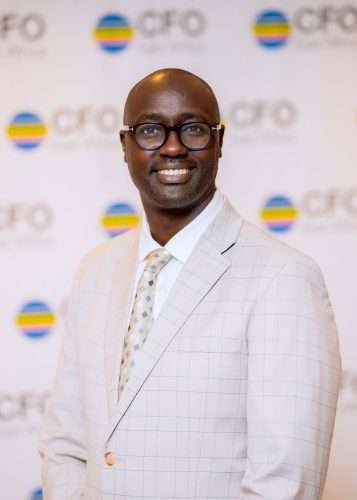
Setting up a finance function from scratch demands both patience and precision. Ampersand Energy finance head Collins Otieno, Bank of Kigali group head of finance Ange Ntiranyibagirwa and Dolphin Professional Services CFO Noel Ngonyani describe the steep learning curve that comes with building systems from the ground up.
Years ago, when he was the finance manager at Pula, Ampersand Energy finance head Collins Otieno was tasked with setting up a finance department for the young agritech start-up. There were no precedents or playbook. He had to establish structures and set up controls while ensuring the organisation’s operations ran uninterrupted. The challenge was both technical and psychological, as it involved convincing people that finance could be a catalyst for growth.
“I developed this analogy in my head. Corporates are like complete buildings and we are doing maintenance work. But start-ups are construction sites. You build from the ground up. You set things up and they go with your name printed on them,” he says.
Because resources were limited and time was short, progress often meant prioritising structure over perfection. Collins remembers having to choose which gaps to close first, knowing both could not move at once. Those moments taught Collins a kind of humility that he believes one can only learn through building from scratch.
“If you just do your stuff, you’ll make an impact. There is a framework document sitting somewhere that was developed by Collins. That’s the good thing about being in a start-up. You set things up and they go with your name printed on them,” he explains.
High stakes
When Ange Ntiranyibagirwa joined Tigo Rwanda as the company’s first financial controller, there was little more than a business plan and a bold vision. His first task was to recruit and train a finance team capable of handling growth. The system had to be built even as the company launched products and opened outlets across the country. Each decision carried high stakes, because every error had the potential to slow the company’s fight for market share.
“Sometimes you would not sleep, trying to think. What can we do? Compete on price or compete on market share? That’s where I started defining myself not as the traditional accountant we knew, but as a partner to the business. Some decisions come fast and you have to analyse the benefit of the decision,” he reveals.
The early months were marked by long nights and constant problem-solving. Ange now believes that to build from the ground up, a CFO must embrace both leadership and learning. Beyond designing controls, one must also model calm in time of uncertainty. Over time, Ange learned to see finance as an instrument that brings clarity.
“You have to position yourself to define what you are doing now, in the first year, the second year, etc. It was a game changer for me. I realised I could not just be an accountant but part of the business team. That is what I carried forward to every role after that,” he says.
Across borders
The moment Noel Ngonyani walked into Dolphin Professional Services, he understood what the assignment was. The company had begun the process of setting up operations across eight African countries, and as CFO, his task was both strategic and cultural. He began to brainstorm about introducing systems that would allow the company to scale in markets with different regulations and expectations. The greatest challenge was balancing the need to show progress while allowing people to grow into the new structure.
“I am not the type of finance professional who has been spoon-fed. I’m a practical guy, and while I play by the book, I have a mindset that goes beyond the books. If there's a problem, I will customise the solution based on what I need to achieve,” he explains.
In Noel’s environment, each decision carries consequences across borders. The speed of expansion also means he has to rely heavily on trust and delegation. His goal is to strengthen the company’s financial capabilities and leave behind systems that can run without him.
“I want us to build strong financial muscle to make this expansion possible. Personally, I also want to invest in my development and mentor others. I want to ensure what we build now endures,” he says.