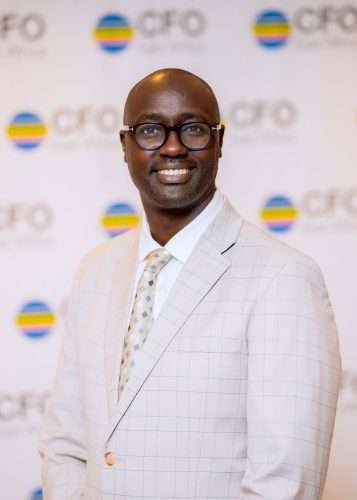
Though the CFO nomenclature has continued to hold in most offices, the role of its holders continues to undergo significant transformation, writes Stanbic Bank Chief Finance and Value officer (CFVO) Dennis Musau.
I wanted to be an engineer! My father worked for Kenya Power and Lighting Company as a technician, and I was always fascinated by the sense of importance attached to his job. Lights would go out anywhere around town, and he (with his colleagues) would have to go to the office immediately to fix them. That was cool.
I switched to pursuing finance following in the footsteps of my late elder brother, Nick. He was a CPA working as an accountant at an economic processing zone (EPZ) in Mombasa. He seemed to work less than my dad, but he (seemingly) made more money – or maybe it’s because he had less responsibilities at the time. So I pursued finance, wanting to be an accountant one day or better still: a CFO.
Fast forward to the launch of CFO East Africa in October 2023, when the audience of about 75 finance executives were asked what CFO stood for, in their own words: Chief Fun Officer, Chief Funk Officer, Chief Frugal Officer and of course Chief Finance Officer came up.
Comprehensive value creation
I left the event wondering how I would define Chief Finance and Value Officer (CFVO), my official title at the office. I wondered whether I have, in my actions, given meaning to the V in the title. I wondered whether the value management role finance executives are increasingly expected to do is worth the call-out or if it’s a passing fad.
In a business world characterised by rapid evolution, I can only think of one more role that’s undergoing as much transformation as the CFO role; that’s the CIO. The world of technology evolves so fast that in a room full of technology executives, you may struggle to find more than a quarter with the same official title in the workplace; some are CIOs, some CTOs, some CIDOs, some CEOs, etc. What’s common is the C and the O – but I digress!
Though the CFO nomenclature has continued to hold in most offices, the role of its holders continues to undergo significant transformation. Traditionally tasked with managing an organisation’s financial operations, including risk management, financial reporting, and liquidity management, CFO roles are now transitioning to reflect a broader shift in organisational priorities including focusing on comprehensive value creation models that encompass strategy formulation, risk anticipation, enterprise sustainability, and socio-economic relevance, among other facets.
The transition has its genesis in the growing complexity of market systems, technological advancements, and a heightened focus on sustainability and corporate responsibility. Stakeholders all round, including investors, customers, governments and employees, are increasingly expecting organisations to live and demonstrate holistic outcomes, not just financial profitability and good ratios, but also contribute to societal and environmental well-being. This shift in expectations necessitates a CFO to re-evaluate their priorities shifting from rear-view mirror reporting and past-tells-the-future budgeting to influencing creation, enhancement and protection of enterprise value.
A three-pronged approach
One area where CFOs can lead the transition into value management is the integration of sustainability and ESG principles into the core business strategy. As they often hold pole position in strategy formulation, resource allocation, and capital deployment, CFOs can drive long-term sustainability alongside profitability.
Sustainability need not be a department, but a central part of creating and protecting value in organisations – and the CFO holds a prime view on this.
To achieve this, the CFO needs to, firstly, drive alignment between the organisation’s financial goals with its long-term vision, ensuring that value creation encompasses economic, environmental, and social dimensions.
Secondly, the CFO must also see beyond financial risks, scanning the environment for what climate damage, governance failures, reputational hazards etc. may impact the organisation’s sustainable success.
Lastly, the Chief Frugal Officer must find the right balance between cost efficiency and the appetite to fund innovation and transformation, finding new technologies and business models that promote efficiency, sustainability and value creation.
Broader and deeper
The transition from CFO to CFVO is not without its challenges and CFOs must not expect a red carpet. It requires a broader set of skills beyond the financial domain, including deeper appreciation of globally relevant sustainability issues, expanded stakeholder engagement, and measurement of non-financial value.
Furthermore, CFOs must carefully navigate the short-termism of most capital providers against the long-termism of enterprise and societal needs.
It is not all doom and gloom, the transition presents numerous opportunities. Value-management embracing organisations are likely to better innovate and adapt to changing market demands, attract and retain talent by demonstrating a commitment to social values, and access new markets and investment by showcasing their sustainability credentials. Moreover, by taking a holistic approach to value creation, these companies can enhance their resilience against risks, ensuring their long-term success and sustainability.
In conclusion, the evolution of CFOs into CFVOs - however scary - is inevitable. As the business environment becomes increasingly complex and interconnected, the need for the traditional CFO will fade, paving the way for value managers who are critical in steering organisations towards sustainable success. So, the new expanded remit is here, let’s embrace it fellow Chief Fun Officers!