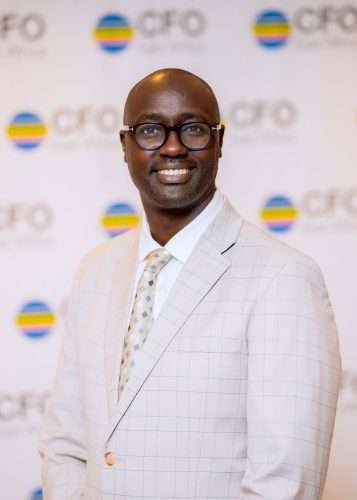
Mastercard Foundation finance director Winnie Waweru asks the same question in every room she enters: Where is the voice of the young people?
Sixty percent of Kenya's population is under 35. They are the country's consumer base, its future workforce and its next generation of finance leaders. Winnie Waweru, finance director at Mastercard Foundation, wants to know why so few of the people with the power to change their circumstances are doing anything about it.
“Considering they make up the majority of our consumer base and our current and future workforce, I kept asking where the young voices in the room were. We should one day have a panel of young people and just listen to them as CFOs,” she says.
Winnie has spent years watching capable, hardworking young people run straight into a system designed to slow them down. When she reflects on the opportunities that came her way by the time she was 30, including work she genuinely loved, which she attributes to God’s grace, there is a stark contrast. She still meets young people who are financially adrift years after graduating, through no fault of their own. Her vision, one that aligns deeply with the Mastercard Foundation’s mission, is for every young person to learn and prosper. Being part of an organisation that puts that at the centre has been, in her own words, a true blessing.
What Winnie wants from CFOs is intentionality, specifically around procurement, payment terms, internships and how the S in ESG is actually being applied. Her concern is that too many organisations have let the social pillar shrink into a narrow conversation about gender and inclusion, and in doing so, have missed one of the most powerful levers available to them: young people.
“When you talk about social impact, talk about the young people in your company and how many young people you have intentionally employed. When you are procuring within your value chain, consider enterprises owned by young people. Even something as simple as buying Christmas gifts for staff is an opportunity to buy from a young entrepreneur. If we are getting a cake for the office, go and buy from that bakery owned by a young person,” she says..
Keeping businesses alive
A 120-day payment cycle is standard practice in many large organisations. But applied to a young enterprise, four months of waiting can be the difference between surviving and shutting down. Winnie’s point is that CFOs control those systems. They are in a unique position to offer more favourable payment terms and keep these businesses alive long enough to find their footing.
The counterargument she hears most often is that youth-focused procurement compromises quality, or that redirecting ESG spending hurts the bottom line. She pushes back on both. As she sees it, if the gift budget was already allocated, buying from a young enterprise does not cost more. It does not mean you settle for less quality either. The real work, she says, is in finding the right vendor.
“The worst thing you can do is make people feel that diversity and inclusion is a compromise. We can absolutely provide opportunities for young people and still achieve our organisational objectives from a P&L perspective,” she says.
In one Mastercard Foundation programme in West Africa, young people were trained in poultry farming, working with high-quality starter chicks and operating in organised and accountable groups. The results were good enough that multinational firms began substituting imports with locally produced poultry.
A chance to show up
Winnie once met a young woman who had nearly forfeited her position in a training programme, because she had lost hope for a better life. It took community mobilisation just to get her through the door. She learned tailoring, then went on to master embroidery, a far more specialised skill. Today, she has a shop and has employed other young people. Her story is one among thousands. And what it shows, consistently, is that when the opportunity is right and the investment is made, young people can build something. Winnie urges CFOs not to shy away from being part of that.
“As employers, we can choose to be intentional about hiring young people into meaningful roles and then actually trusting them to deliver,” she explains.
Recently, Winnie worked closely with a group of interns for close to a year and was genuinely impressed by their drive and hunger to contribute.
“The narrative you see on social media about young people not wanting to work is simply not the full story. We need to invest in finding the right people, and then give them the chance to show up,” she says.
The barriers facing young people in Kenya are structural and they compound on each other. Access to finance remains out of reach for most, while the cost of formalising a business is often prohibitive. And with university fees continuing to rise, even the path through education is narrowing.
“These are not problems that will resolve themselves. I do not want us to wait for the government. We, in our personal capacity and in our companies, can act now and start shifting the ecosystem,” she says.
For the CFO community specifically, Winnie has a concrete proposal.
“Use the quarterly meetups we already have to create a young people’s forum. Invite them into the room. Let them speak. Let us hear directly from young people what they need from us as finance leaders.. We talk a lot about impact. This is one place where we can create it,” she says.
The views and opinions expressed in this article are those of Winnie Waweru and do not necessarily reflect the official position, policy, or views of the Mastercard Foundation.