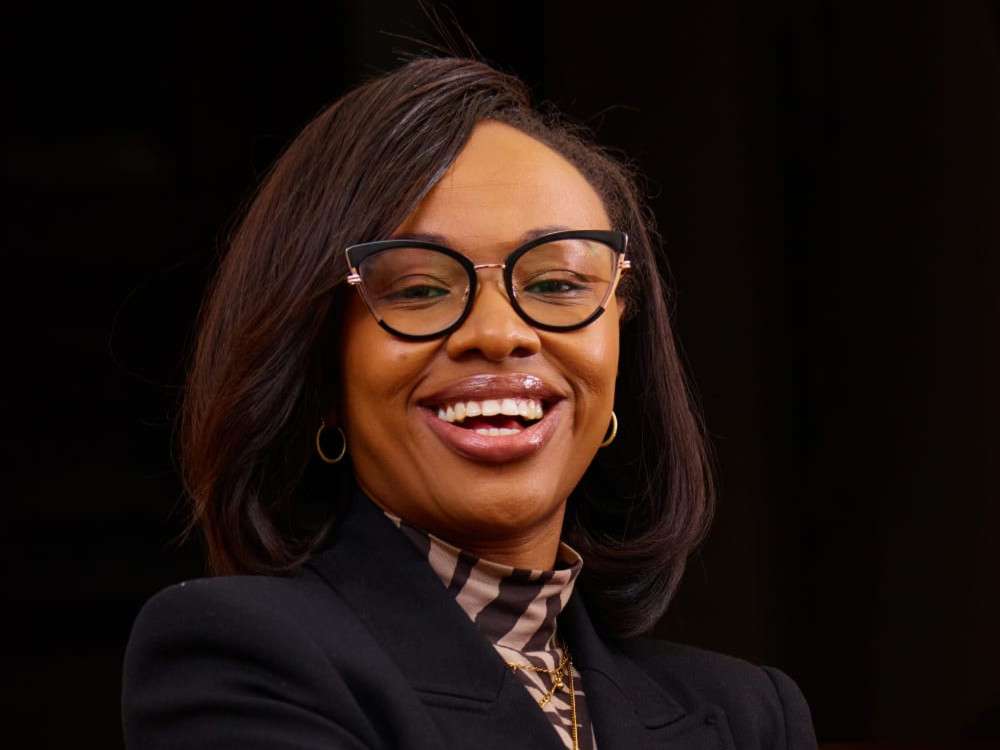
Daisy Wanjie has spent her career at the intersection of finance and impact. She explains how the organisation she helps lead is closing one of the continent's most persistent financing gaps.
Somewhere in Kisumu, a motorcycle rider is putting two children through school. In Nairobi's Muthurwa Market, an entrepreneur is running a growing delivery business from a three wheeler. Neither of them walked into a bank and walked out with a loan. They got their financing because a financial institution had enough confidence to approve it, and that confidence came from a guarantee. As CFO Daisy Wanjie describes it, this is what African Guarantee Fund does, turning ambition into capital.
"African Guarantee Fund was created by impact investors with a core mandate to facilitate access to finance for SMEs. How we do that is we provide guarantees to financial institutions who then on-lend to SMEs. We do not really lend the money ourselves, but we work through financial institutions," she says.
Across Africa, there are millions of entrepreneurs with the ambition and the business plans to justify financing. Banks want to lend but are held back by the perceived risk of lending to small businesses, which are often under-collateralised and operating in volatile environments. AGF steps in between the two sides, providing a partial guarantee that makes the deal possible. Every dollar it deploys in guarantees generates 24 dollars in lending that would not otherwise have happened.
A mandate in three parts
For Daisy, the ESG dimensions of AGF's work are essential to its operations. Each pillar of the mandate targets a gap the market alone would not close.
AGF-backed financing has connected 53 million people to clean energy and supported 97 megawatts of renewable capacity across the continent. A blue economy facility runs alongside the green guarantee programme, extending the same risk-sharing model into marine and water-linked sectors.
"We offer green guarantee facilities to financial institutions and incentivise them so that this can be cheaper for them. We also have a blue economy facility, and for the social aspect, we also have a facility under women," Daisy says.
Through its AFAWA initiative, the fund has also backed 16,000 women-led SMEs with $1.05 billion disbursed in loans. The mechanism is the same as the core model. AGF absorbs part of the risk, the bank approves the loan and capital reaches businesses that the market alone would have passed over.
"We work with financial institutions to lend to women entrepreneurs and the underserved communities. SMEs, basically, banks sometimes perceive them to be riskier, and it is very difficult for these SMEs to access finance, so we come and give that comfort to the financial institutions," she says.
Strengthening the system
The governance pillar is where Daisy's work moves closest to the concerns of the finance chiefs AGF serves. When a guarantee gets capital to a business, what happens next depends on whether that business is structured well enough to use it productively and whether the institution lending it has the risk management tools to do so responsibly.
"For the governance part, we have a technical assistance fund. We fund financial institutions to ensure that they have a robust risk management structure, and we also fund the SMEs. We give them funding to make them formalise, because most SMEs are informal, and to make sure that they have proper management structures to run their businesses," Daisy says.
Across its history, AGF has reached more than 53,000 SMEs, trained over 3,900 people across its network and strengthened more than 26,000 businesses through its capacity development programmes. It operates through 256 partner financial institutions in 44 countries. The $421 billion SME financing gap across Africa is not a problem of capital availability. It is a problem of risk confidence, and closing it is what Daisy shows up to do every day.
"It is part of our DNA. That is what we do," she says.