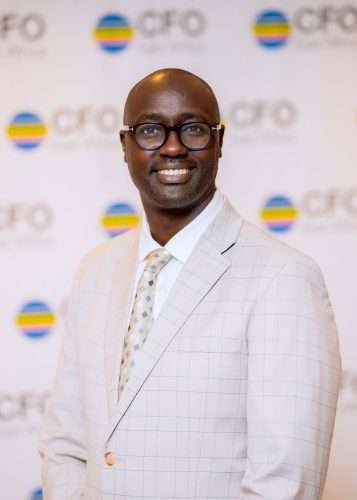
Many people have the impression that the public sector is slow, inefficient and bureaucratic. This is not necessarily the case in Kenya today, according to Stephen Vikiru Kinadira, general manager: Finance at Kenya Power and Lighting Company.
Many people have the impression that the public sector is slow, inefficient and bureaucratic. This is not necessarily the case in Kenya today, according to Stephen Vikiru Kinadira, general manager: Finance at Kenya Power and Lighting Company (KPLC),
“Working in the public sector has its advantages, there is a bigger space which offers opportunities for growth and a reasonably stable environment for those seeking long-term employment up to retirement. It is also fast-changing with the government embracing technology and other modern practices to drive efficiency in service delivery. The government is also investing a lot in talent development through training as well as attracting highly qualified staff even from the private sector. They now offer competitive packages to retain the right human resources,” he explains.
Stephen has fond memories of growing up in Amalemba in Kakamega town, playing football with the boys in the dusty municipal field that was converted into a mobile cinema late at night. His father was a district accountant with the Department of Revenue (now Kenya Revenue Authorities) and played a role in influencing him to become an accountant.
Stephen pursued a Bachelor of Commerce in Finance at the University of Nairobi, graduating in 2004. Four years later, he graduated with an MBA from the same institution. Other than brief stints at Heritage Group of Hotels, Stima Sacco Society and the Capital Markets Authority (CMA), Stephen’s career has largely been at KPLC working in different roles.
“I have been privileged to work in unique areas of this organisation, starting off in financial reporting followed by tax accounting and compliance. I participated in financial planning and modelling which entailed quite a bit of participation in tariff determination and reviews as well as power purchase agreements. I was at some point seconded to the Rural Electrification Authority and have also served on numerous energy sector forums which have helped me to understand the company and the sector at a much deeper level,” he says.
Collaborative and sustainable
Stephen finds fulfilment in the sector when compared to his time at CMA, where he was responsible for routine tasks. KPLC presents unique challenges that keep him engaged and he is often involved in complex problem-solving situations at the parastatal. His current pre-occupation is crafting a long-term strategy for financial sustainability seeing as the entity has recently reported its second loss in two decades.
Stephen is assisted by four finance managers in leading a team of over 300 finance department staff spread across the country. His leadership approach lends itself to a collaborative and participatory style that is results-oriented, down to earth, and as supportive as possible to the team.
As a government-owned entity, there is a certain amount of red tape to contend with. For instance, to open a simple bank account requires the GM to invite bids from across tier-one banks, determine the bank with the most favourable terms and then obtain separate approvals from the board, the Ministry of Energy and National Treasury. These numerous - and necessary governance - steps tend to hinder commercial agility.
“In my role, there is a need to be familiar with all laws and regulations. This should be a trait that all modern CFOs should exhibit as the role has evolved from simply concerning oneself with accounting and treasury matters. CFOs today should be aware of the benefits of technology and how tech can be used to comply with the many standards and regulations that are consistently emerging,” Stephen says.
Asked about his view of success, the married father of two girls says it is about understanding one’s desires or ideals.
“Once you know what it is you desire, you need to determine the goals that need to be achieved in order to get there. You need to determine where you are and what you need to get there. It is also crucial to know when a goal has actually been achieved so that you can move on to new goals as success is a continuum,” he adds.
One book that was life-changing for him was Psycho-Cybernetics by Dr Maxwell Maltz. It explains how the self-image has complete control over an individual’s ability to achieve any goal and contains techniques for improving and managing self-image — visualisation, mental rehearsal, relaxation.
“The book taught me to handle the many difficult situations I have encountered in my career and especially here at KPLC. I learnt to appreciate that these are not life and death matters; I avoid overthinking them and apply techniques aimed at understanding and protecting the inner me,” Stephen concludes.