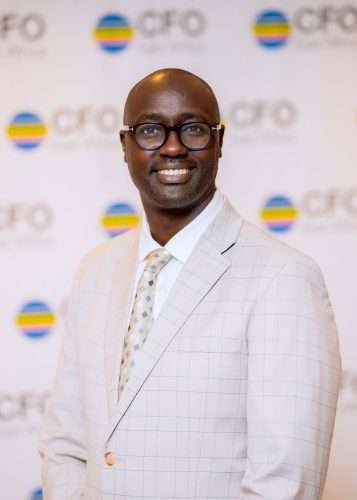
As head of finance at then KenolKobil (now Rubis Energy Kenya), John Githiomi participated in investor roadshows in different parts of the world between 2017 and 2018. It was through these engagements that the French energy conglomerate, Rubis, became interested in acquiring KenolKobil and, as John was the custodian of financial information, he found himself at the centre of the acquisition.
“It was an intense period as we had to seek requisite approvals from Comesa, the Competition Authority, Nairobi Securities Exchange, Capital Markets Authority and Energy & Petroleum Regulatory Authority. After seeking the suspension of share trading, we had to come up with a shareholder circular, send out the offer documents to shareholders and engage an independent advisor to provide a fairness opinion to shareholders, among so many other things. The process began in October 2018 and was concluded by mid-March 2019,” John recalls.
John is the group CFO of Rubis Energy in East Africa with responsibility for finance in six countries, namely Kenya, Uganda, Rwanda, Ethiopia, Burundi and Zambia. He also serves as a director for Rubis Kenya and its affiliates. The company has recently made downstream asset acquisitions in Uganda, Rwanda and Zambia.
“We have also acquired the downstream business of Gulf Energy in Kenya comprising 46 fuel stations and commercial contracts. Our mix of acquisitions were not all the same. In some instances, we acquired entities as going concerns while in others it was purely an asset acquisition,” John explains.
“Mergers and acquisitions (M&A) can be challenging, and I attribute the success of the ones we have undertaken to the great team at Rubis. When I am recruiting members for my team, a critical factor is what unique skills they bring to the table. I favour individuals who possess knowledge and talents that are different from mine,” he adds.
Credibility
John has seen the benefit of inculcating seasoned professionals into his finance team, people “who have been properly trained in big audit firms with an understanding of the relevant standards to account for complex transactions such as acquisitions”.
“I like people who can work independently and are innovative. When we have a challenge, I do not expect a single person to tackle it but rather create teams of a few people to work on it together and support the solution with credible case studies that can withstand challenges when put forth to auditors,” John says.
Other M&A lessons that John has gathered from his experience is the importance of proper due diligence. He asserts that a buyer should never trust what is presented to him by a seller and should rather involve professionals to interrogate the numbers.
“On a few occasions, you may have a target that looks great on the surface but after scrutinising the details you discover that there is no business. Furthermore, valuation is very important because sellers often have an exaggerated view of the value of their business. It could be that they base it on the assets that they possess, yet buyers are mainly concerned with the ability of those assets to generate cash,” John explains.
As a respected finance chief within the petroleum sector, John is the chairperson of the technical committee for CFOs in the industry, which encompasses the finance chiefs of all major oil marketing companies in Kenya. Among the challenges that they have tackled recently was converting the non-interest earning fuel subsidy receivable from the government to a treasury bond. This reduced the finance cost arising from delayed payments to oil companies.
“We also succeeded in lobbying for a change to the manner in which the regulator sets pump prices. Previously, this was done based on the official exchange rate which impacted our margins negatively. This has since been amended to use market rates which are more representative of the cost of fuel,” John explains.
Retaining talent
Within Rubis, he has a collaborative approach to leadership where team meetings are held regularly to allow staff members to express their points of view. To encourage openness and ensure staff asked all the tough and uncomfortable questions, John introduced the use of the Padlet system, which allows staff to pose questions anonymously.
“I am only interested in the question and not the person that is asking it. Once issues are raised, I give a timeline within which they will be addressed and assign someone to the team to be responsible for following up. This has built trust within the team as they feel heard on different matters including salaries, promotions and job rotations. As a result, the fear of losing good talent is not a major headache for me,” John states.
The fifth child in a family of nine decided to pursue accounting and followed in one of his brother’s footsteps. After graduating with a BCom in Accounting from the University of Nairobi (UON) in 2004, he worked for Chase Bank and EY before joining KenolKobil in 2007. He obtained an MBA in Finance from UON in 2014. He is currently pursuing the Advanced Management Programme course at Strathmore University Business School.
The married father of two girls and a boy admits that he struggles to achieve work-life balance. “I get off work quite late; around 8pm. On my way home, I stop by Parklands Sports Club for a run around the wonderfully designed track they have at the club. I am not a morning person; I run at night but I am not a night runner!” he jokes.