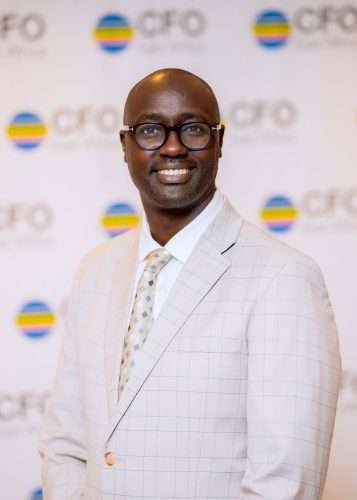
KCB Group has announced a record interim and special dividend totalling Ksh 4 per share. Group finance director Lawrence Kimathi is keeping customers at the centre of every decision as the bank works to meet ambitious targets in the second half.
KCB Group posted a net profit after tax of approximately Ksh 32.3 billion in H1 2025, an eight percent increase from the same period last year. The bank declared a historic dividend payout of Ksh 4 per share, split evenly between an interim and special dividend, totalling about Ksh 13 billion. The results were framed as a measure of how well the bank is delivering on its 2024 to 2026 plan. As group FD Lawrence Kimathi notes, the numbers reflect progress, but the second half will demand sharper execution to meet ambitious goals.
“We were very aligned to our strategy. So the main sector that grew in loans was energy, which is one of the areas that in our Transforming Today Together strategy we called out as underserved and required the bank with the size of our balance sheet to start participating in a big way. Industrials, which in many other places you would call manufacturing, was also an area where our loan portfolio grew in comparison to previous years. And lastly, infrastructure, which started growing towards the end of the second quarter and that talks to the innovative solutioning to unlock pending bills related to roads construction,” he says.
The first half saw an improvement in asset quality. Non-performing loans fell both in ratio and in absolute terms, which the finance director linked to specific recovery and restructuring efforts as well as the impact of the NBK sale. Lawrence made it clear that cleaning up the loan book is an important step in creating room for growth.
“The ratio has dropped 60 basis points to 18.7 percent. Good news is the stock has started going in the right direction. This is probably the only slide where I will say when things go south, we are happy. The non-performing loan stock dropped to Ksh 221 billion. The work that our recovery team has been doing in executing the NPL remediation strategy is starting to pay off,” he explains.
Keeping momentum up
Diversification across the region also played a central role in KCB’s resilience. While conflict in the Democratic Republic of Congo (DRC) has slowed Trust Merchant Bank’s performance, other subsidiaries have stepped up. Rwanda’s BPR Bank delivered a sharp profit rise, while Tanzania continued to grow, and Uganda staged a strong recovery after a slow start. Lawrence reveals that the mix of markets allows the group to absorb localised shocks without losing momentum.
“This is the beauty of having a portfolio of subsidiaries. When one is down another one picks up. TMB played that role for KCB Group for two consecutive years. I am very optimistic that they will make a good recovery in the second half of the year,” he says. Revenue for the period rose four percent to just under Ksh 99 billion, with loan growth offsetting a fall in foreign exchange income. Lawrence notes that stable currencies in key markets had narrowed spreads and lowered transaction volumes. He adds that margins fell in Kenya and Rwanda after lending rates were lowered earlier in the year. However, cost control helped deliver an eight percent rise in profit after tax to Ksh 32 billion.
“I would say costs were pretty well managed. Cost to income ratio came down to 46 percent. From a cost point I think we are doing what we can to ensure that we convert our top line to the bottom. We want to keep that discipline in place,” Lawrence says.
He adds: “All our subsidiaries are well within the regulatory capital requirements. The capital buffers for KCB Uganda and Tanzania are lower than we would like and as such we shall be raising capital for the two. In view of this and having carefully forecasted future capital needs, the board was happy to propose the historic dividend of Ksh 4 per share amounting to a payout of just under Ksh 13 billion.”
Looking ahead to the rest of the year, the finance director indicated that deposits and non-funded income need greater focus. According to Lawrence, limited cash in the market has slowed deposit growth and lower FX income has pushed the non-funded income ratio below 30 percent for the first time in years. The rest of the year, he noted, will need quicker action to meet budget goals.
“The targets we have for the second half of the year are extremely stretched so we have to double our efforts. It starts with putting the customer first. The customer is the person who pays you. If you do not put them first then I am wondering who you are going to put first,” he says.