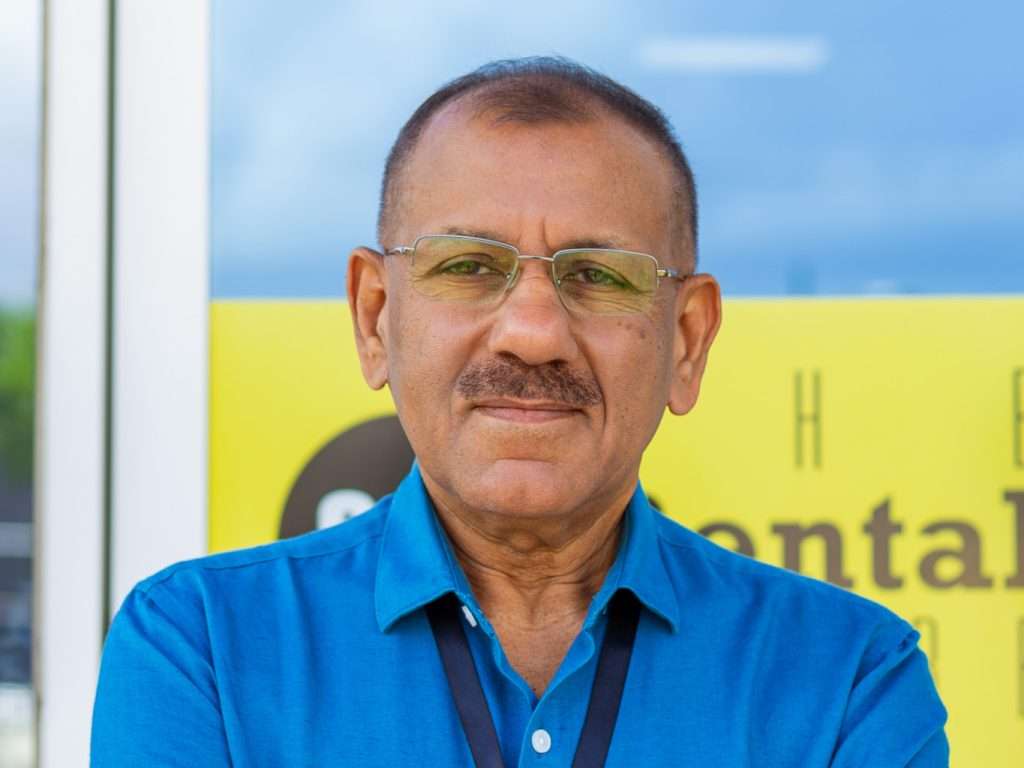
Mantrac Tanzania finance director Sudhir Khanna has spent over four decades building resilient finance teams across India and Africa, always leaving them stronger than he found them. He believes the future of finance will be shaped by technology and 'doing business the right way'.
When the Covid-19 pandemic struck in 2020, Sudhir Khanna, like most people, was not sure how the new work-from-home protocols would turn out. He was based in Nigeria at the time, where he watched everything change overnight.
“Never did anyone think working from home could work in Africa at all, because that was a thing of Europe or the Americas. People could start to see, after a few months, that this should be the way going forward, and on the personal side, I think probably everybody came to the realisation that whatever wealth, fame and power you have accumulated or spent your energies to accumulate all your life is worth nothing when you are in a hospital bed. All of the above can buy one the best treatment but cannot guarantee life,” he says.
Over the 43 years he has worked in finance, Sudhir has lived in a total of seven countries in Africa. He and his family relocated from their native India in 1990.
“The perception then was that Africa was a jungle and animals roam around on the streets, but that perception was totally misconstrued. Africa has probably the best weather to offer anywhere in the world. You don’t have the extreme summers of India or the extreme winters of Europe, and I think people are quite friendly. The kind of facilities which you find in Africa, like the bigger houses and the comforts, you can’t even think of in Europe or anywhere. Life here definitely has its own challenges, but I think there are positives,” he says.
Sudhir and his family had intended to stay in Africa for only three years, but 34 years later, they feel more at home here than in India. For the last eight years, Sudhir has served in various capacities at Mantrac, most recently in Tanzania. The joy of work, for him, is in the capacity to educate and influence the decisions of the business.
Making better decisions
“We educate the team and our colleagues about the financial implications of any actions we take, because at the end of the day, businesses exist because of the stakeholders and all of them expect returns in their own way. Everything you do has results. So, I like helping my colleagues and my teams make better business decisions for the benefit of all stakeholders,” he says.
As a child, Sudhir had an inclination to study finance. His father was a banker, and with time, he began to see himself going down the same path. Some of his most vivid childhood memories are conversations about business, which he suspects had a hand in his decision.
“I think that’s probably where the monetary genes would have come from, because I saw and heard talk of money all the time. I grew up, and there was a natural instinct for commerce,” he says.
Four decades in, Sudhir believes that finance is largely the same as when he began, except for advances in technology and the increasing automation of processes. In his view, what sets finance professionals apart is the ability to interact with and understand all aspects of the business. He therefore cautions early-career executives against working in silos.
“If you are limited only to finance and accounting, you understand only that part, but if you get involved with other business activities, then you really appreciate the other side of the coin, and you know what to do when you are confronted with a problem. With the exposure to all aspects of the business, you can make a more educated decision or judgement and take action accordingly,” he explains.
Staying alert
For this reason, Sudhir likes to keep a pulse on the happenings around him. He advises finance leaders to adapt to the twin forces of AI and automation or risk becoming obsolete. However, he warns that continued oversight is needed. He also sees sustainability becoming more central to how businesses operate and cater to the needs of the hour.
“You need to think about your environmental footprint, how you treat your employees, and how you show up in the community. It’s not just about hitting targets. Your business must have a conscience. That’s what stakeholders are looking for now,” he says.
To bring the best out of his team, Sudhir involves everyone in his decision-making. He encourages his team members to take pride in their work and challenge themselves every now and then.
“They’ve got to ask themselves, ‘Why did I choose finance as a career’? Obviously, to add value to the activities of the business. Are they meeting those expectations? So, I think I’ve been quite successful working with teams overall, ever since I started my career, and I’ve got more out of my teams compared to what they were before I started to deal with them,” he says.
Sudhir considers himself to have something of a Midas touch, having consistently left the teams he managed in a stronger position than he found them.
Leading with empathy
“It has happened in other organisations before, where people had a lot of complaints about the output of the teams. Things don’t happen on time. The vendors are complaining. And I think with my involvement and basically either mentoring the team or getting involved with that team at the grassroots level, I’ve been able to manage to turn things around and get a better output,” he reveals.
But the journey has not always been smooth. Sudhir recalls a particularly difficult experience at a previous employer, where he had worked for 21 years. At the time, he was based in Angola and a new supervisor had just joined the company. The supervisor had no prior experience with the business and tensions began to brew soon after.
“They ended up making some decisions that were totally not professional. They spoilt relations with a lot of people, both in the finance and non-finance sections. When I saw that things were not improving and there was no way to manage that relationship, I decided to leave the organisation. It was the hardest decision of my career. But I later found I wasn’t alone with these feelings. Probably 60 to 70 percent of the people who had worked long-term with that organisation are no longer there. That shows how quickly things can change because of one single person,” he says.
That experience, painful as it was, proved to Sudhir the value of leadership rooted in empathy and mutual respect. It also deepened his appreciation for the community he has found in Africa, a place that has, over the years, come to feel like home. His children, who now live in the UK, come home whenever they can but still love visiting Africa.
“When we travel to India, we come back to Tanzania and feel we are back home. We go to India, and it feels like we are visiting, not returning. That tells you how much this place means to us. Wherever we are, Africa has remained our constant,” he says.
Outside of work, Sudhir is intentional about unplugging. He believes in setting boundaries between work and personal life, often putting off checking his email until he is back at work. Twice every year, he and his wife visit their children in the UK. They also enjoy shopping in Dubai.
“But moving forward, I’d also like to explore more of Europe. I also spend quite a bit of time watching current affairs. I like YouTube videos on food, travel, or research-based topics. It could be anything that’s interesting. That variety keeps me engaged,” he says.