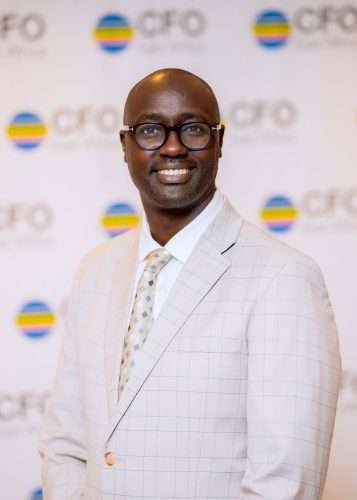
Speaking at CFO South Africa's CFO Day, Juma Kimori laid out a rigorous case for why the finance leader's job is to deploy cash with discipline and what happens when they get that wrong.
The first question NMB Bank CFO Juma Kimori asks when he looks at his balance sheet is how much of his total asset base is earning. The finance chief of Tanzania’s most profitable bank sets a concrete internal measure for this. This is the lens through which he evaluates whether the organisation is managing cash or simply holding it. The distinction between the two is the difference between a resilient institution and a deteriorating one.
" You put a target to say we need more than 80 percent of our assets to be earning assets. That means the concentration of loans and advances, government securities, and any cash that you have invested somewhere else and generating a return. The moment you have cash sitting in a silo, you are deteriorating the value to the shareholders," Juma said.
What Juma describes requires holding four competing demands in balance at all times: equity resilience, capital efficiency, growth investment and shareholders' return. These demands pull in different directions and as Juma warned, the CFO who prioritises one at the expense of the others will eventually face a reckoning.
"The failure to balance your liquidity can result in reputational damage to your organisation. It can also make you unable to take emerging opportunities," Juma went on.
The approach Juma relies on to navigate that balance is scenario testing. He builds minor, medium and major scenarios, stress-tests his cash flow against each, and uses the results to construct a contingency funding plan for whichever materialises. The exercise demands a working knowledge of geopolitics, regional dynamics and local operating conditions

Have a plan
"We have gone through Covid, we have gone through other aspects happening in the globe, and this can repeat and recur in the future. You need to be forward-looking and ask what it will look like if this thing materialises, and how you then mitigate that. You cannot probably 100 percent mitigate, but at least you have a plan to demonstrate that journey,” he explained.
The sharpest illustration Juma offered was drawn from pension funds, and it functions as a warning that applies to any organisation with recurring obligations. Some pension funds, he observed, tie their capital into long-term illiquid assets whose returns are insufficient to meet the daily obligations that fall due as members retire.
"Someone has contributed 25 years as a pensioner. When he retires, he does not get the money on time, just because of liquidity issues. Cash is tied somewhere else, in a long-term investment that does not generate enough to settle the recurring expenditure,” Juma said.
Juma’s account of how NMB Bank handled the arrival of mobile network operators (MNOs) in the payments space illustrates the ability to reframe a threat as a structural opportunity. When MNOs entered the space, the banking sector felt the pressure of encroachment, as MNOs are, by the nature of their revenue model, structurally cash-rich. Juma watched that reaction and drew a different conclusion.

Opportunities for partnership
"Over time we have come to learn that these are huge opportunities for partnership. MNOs are very much cash-rich because their customers pay before they consume, so we leveraged those relationships to ensure that we are also liquid to that extent,” he revealed.
The sessions at CFO Day, Juma noted, reflected a change that has already taken place. The custodian model, in which the CFO's primary function is to protect the asset base, no longer fits the demands of the environment. What the environment now requires is a finance leader who reads global events as they unfold and works out, in real time, what they mean for a specific business in a specific market.
" It is time that calls for a future and forward-looking approach, and that comes with not only staying in your corner but being abreast of what is happening globally. You need to be aware of the environment, both local and global, and that requires you to take a deliberate move in terms of reading a lot, listening to the news and understanding what is happening. A proactive approach is much better than being caught by surprises,” Juma said.