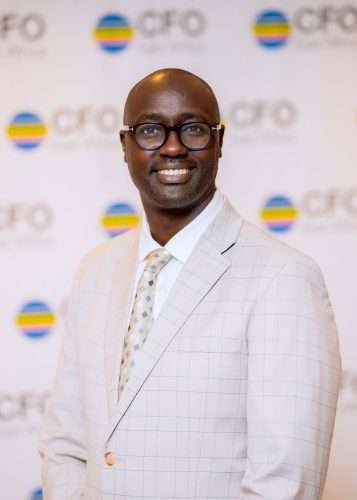
At NSSF Uganda, CFO Stevens Mwanje has recast the role of finance and helped steer investments towards small businesses. In his view, the work is about building systems that shift how money works in people’s lives.
Unlike many finance professionals, who discover a love for numbers early on, Stevens Mwanje chose the path deliberately as a gateway to leadership. At the beginning of his career, he realised that if he wanted to understand how companies worked and influence decisions at the top, he needed to become familiar with finance. Though he started as a teller in a bank, his ambition was to understand the machinery of business and have a seat at the table where strategy is made.
“I just wanted to get the knowledge. I said to myself, ‘You can't be good at the C-suite if you don’t understand numbers’. So I started doing accounting courses, finished my ACCA in less than three years. That’s how I ended up as a CFO,” he says.
At the National Social Security Fund (NSSF) Uganda, Stevens’ work is as strategic as it is financial. He talks less about figures and more about how money can enable transformation. His focus is creating a finance function that supports long-term value, financial inclusion, and national development. That thinking has earned him multiple industry recognitions, including a recent nod in the Top 50 CFO of the Year category at the fifth CFO and Public Finance Awards.
“You need to learn things like emotional intelligence, negotiation and communication. You must make time to learn those deliberately. That is how you grow beyond your training and become a real enabler,” he says.
Forward-looking partners
The shift was part of a deliberate plan Stevens made when he was appointed in 2017. He led the restructuring of the finance team to reflect a more agile and strategic model with the goal of aligning it with NSSF Uganda’s priorities and supporting faster execution. This move also encouraged shared ownership and quicker decision-making. Beyond accounting and reporting, he focused on learning how to communicate, negotiate and manage people. His view is that finance professionals can no longer rely on technical skill alone.
“The role of finance has changed. You are no longer the backward-looking person who just records things. You must be a partner to the business. You must enable decisions and direction,” he says.
He expects the same of his team. Stevens often pushes them to broaden their skills and become critical thinkers. At the pension fund, he is building a finance team that questions data and collaborates across departments while contributing to decisions. In his view, that is what makes finance a real partner to the business.
“I tell my team, ‘Do not just produce reports’. Ask questions about the numbers. Understand the drivers, then come with solutions,” he says.
Transforming the fund
Stevens’ approach has placed him at the centre of NSSF’s transformation journey. From the time of his appointment, he has been involved in shaping strategy and product development, thereby aligning finance with the fund’s broader mission. One of the biggest shifts has been moving beyond traditional employer-based contributions to reach informal workers and underserved communities.
“We are trying to tap into the informal sector. If we can find ways to include the people outside the current system, then we grow. That is where the numbers are, and that is where the future is,” he says.
The fund’s investment strategy also reflects this thinking. Stevens is keenly involved in using the fund’s capital to support national development, from infrastructure to entrepreneurship. He is particularly interested in how NSSF can support small and medium enterprises through structured financing that allows them to grow and formalise.
“You cannot grow a country by funding only big corporations. We must look at the SME space. We must develop vehicles to support them so that we can build a resilient economy,” he says.
This mindset also extends to technology. As part of the push to automate transactions and unlock insights, Stevens has been deeply involved in the fund’s digitisation efforts. He sees data as the key to relevance and agility, especially in a context where member expectations are rising.
“We are sitting on so much data. If we can harness it properly, it will help us understand our members better. It will also help us tailor our services and respond faster,” he says.
Consistent effort
As a leader, Stevens believes influence is earned through clarity and consistency. To get people on board with his vision, he shared his reasoning and created space for them to own their work. During the pandemic, when Uganda went into lockdown, he found small ways to connect with the team and keep morale high.
“During Covid, we were sending cakes to people and celebrating their birthdays together online. We would put on music and dance together virtually. It was a way to keep people connected. I couldn’t be physically with them but I could still show I cared,” he says.
In his view, people work better when they feel seen and are trusted to deliver. That kind of culture, Stevens reveals, takes consistent effort and a willingness to lead by example.
Amid the pressures of his role, Stevens has learnt to protect his focus. He sets clear goals and filters out what does not matter. In a position that demands constant responsiveness, he schedules time to reset, and learn, a practice that keeps him centred and less reactive. He believes that thinking space is as essential as execution.
“You can get busy and be ineffective. So I try to create time to reflect. I read current affairs quite a lot. It helps me recharge and also stay sharp,” he says.
To reset, he turns to music and long walks. These rituals help him to let go of pressure and shift into a different rhythm. They are part of how he sustains high performance without burning out.
“I love music. I play music and I sing to myself. That is what I do when I want to unwind,” he says.