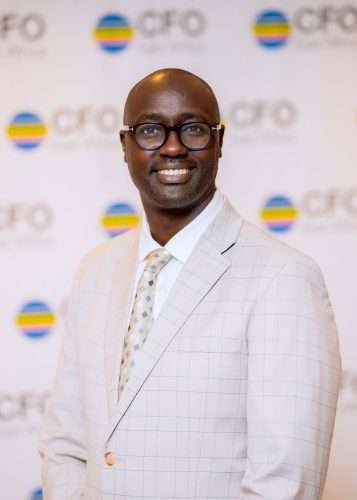
PowerUp head of finance and operations Eva Zalwango brings systems thinking to every challenge. But behind the discipline is a deeper drive to leave people better than she found them.
When Eva Zalwango talks about her work, people remain at the centre: a life insurance agent in the field closing a sale or a mother in Kampala switching from charcoal to an electric stove. What matters to her is whether something she did made someone’s life easier. Her focus is firmly rooted in the daily reality of the people she serves.
“If someone had a problem, however small, but that person is happy because of my input, that’s what motivates me. Usually when I meet people and they say they knew me from somewhere, the first question I ask is, ‘Was my experience with you good or not?’ Because I want to make people's experiences good,” she says.
In 2015, Eva took a risk by joining Goldstar Life Insurance. At the time, the company’s four employees were serving a client base of just over 200, out of a 229 square metre office space with only three desks. The few systems in place relied on spreadsheets. Against her better judgement, she accepted an offer.
“They sold me a promise that Goldstar Life would be acquired by a multinational and become Prudential Insurance. At the time, everything was manual. Even onboarding a client meant juggling papers. The CEO told me to ignore what I saw and believe in what was coming. That was difficult, but I made a choice to trust him. In life, you need to take risks,” she says.
Eva helped lead the transformation after the acquisition, building the finance function from the ground up. She and her team installed an ERP, established financial controls, and built an investment portfolio. By 2021, Prudential Uganda had grown to become the market leader in life insurance. She also pioneered Uganda’s first direct debit model for insurance and spearheaded the automation of Airtel Money standing orders. Although these moves overhauled how policies were paid for and managed, Eva had to advocate for change both internally and externally to gain buy-in.
“At that time, we had to go and do piloting. We had to do a lot of stakeholder engagements because it was the first one of its kind. We had to do that with the banks, clients, and the Prudential back office,” she says.
A shift in mindset
The transformation required a rethink of how finance contributed to business strategy. As Eva sees it, finance is a value enabler. She believes it should shape decisions and support strategy by building systems that work.
“We are a support function, not a reporting function. It’s important that we enhance our backend processes through tech. You can’t enhance your backend processes through headcount. And it cannot start at the tail end, it has to start at the beginning,” she says.
This is why she wants to learn coding. At work, she often relies on programming experts to translate her ideas into execution. But as tech begins to play a bigger role in finance, Eva is eager to become fluent.
“Most of the time when I have initiatives, I’m at the mercy of the programmer. I hold them in very high regard because they have all our solutions. They are the reason why I’ll have a job tomorrow,” she says.
Eva’s uncompromising approach to work was forged in Nairobi, where she studied accounting in her late teens. Acutely aware of her status as a Ugandan transplant, she would stay in the library at Strathmore University until late at night, keen to return home having achieved something.
“From the time I went there, my mum trusted me. She is a single mum. And I thought, ‘Really, I can’t fail her.’ People do ACCA for 10 years, but I decided I was not going to do it for 10 years,” she says.
Doing it right the first time
Eva carried this grit into the implementation of IFRS17 at Jubilee Insurance in 2024. The new standard overhauled how insurers accounted for contracts, profitability, and risk, posing a fresh technical challenge. There were no shortcuts.
“It meant navigating different systems. Not just accounting, but changing the mindset of people. You have to be more critical and analytical in whatever you are doing. It’s not just about doing the bookkeeping. So you’re trying to make people understand and finish the reporting with the auditors, who are also learning. There were very many sleepless nights with the team. But we were able to report. We were able to understand it,” she says.
At PowerUp, Eva is navigating new terrain. Her task is to structure financial models for carbon credits and help quantify the impact. Despite the complexity of the work, Eva sees the human value behind every dataset. Although the company’s products are marketed as affordable, they face real-world barriers including access to electricity, cultural norms, and upfront cost.
“Carbon credits, DMRV, how you translate that information, put it into numbers and then have it traded is what really drew me to the company. Most importantly, the need to help an ordinary person. We help people switch to electric cooking. If I’m able to say that I’m adding value by educating people, I move away from the numbers to the impact, she says.
After years of navigating risk, Eva has learnt that resilience also needs release. The discipline that keeps her grounded at work also pushes her to stay present and active outside of it, giving back to her community whenever she can.
“People usually think I’m a quiet person. No one believes it when they see me dancing at functions. They’re like ‘Who is this?’ But I really like dancing because it feels like a time to let go,” she says.