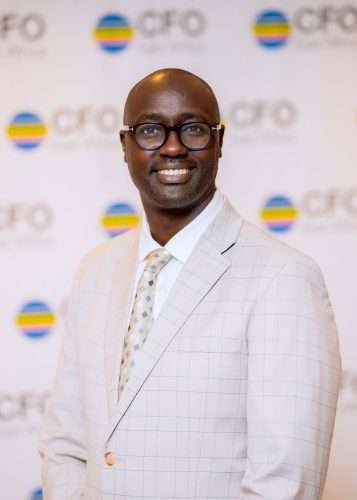
After serving as Rwanda’s accountant general, Patrick Marara Shyaka found that crossing into the private sector came with unexpected challenges. The CFO of Rwanda Fertiliser Company reflects on the changes he had to make and the routines that keep him grounded.
Not many finance professionals in Rwanda have held positions as senior as Patrick Marara Shyaka. He began his career at the office of the auditor general and rose to become the country’s accountant general. But even with his extensive experience, he struggled to gain a foothold in the private sector.
“Some people don’t believe that someone can easily transit from the public sector to the private sector. They perceive all high positions in the government are political. So, it was hard for me to transition from a position of accountant general to CFO. They saw the position as political. And the second part I also felt was people thought it's a different sector, because I was coming from the public sector,” he says.
In 2017, Patrick landed the role of CFO at Agaciro Development Fund one year after leaving the position of accountant general. Although it offered a chance to prove his capabilities in a new setting, the transition was not easy. Having worked with IPSAS throughout his government career, he had to quickly master IFRS.
“I just sat down and assessed myself, looking at what I know and what I need to know. Then from what I don't know, whom can I contact and sit down with? I sat down with different colleagues who are in the private sector, in the audit firms and so on, and tried to probe them about different things. That’s how I managed to adapt,” he explains.
A new approach
With the focus on improving his technical skills, Patrick overlooked the importance of relationships. He admits he did not take time to understand the ways people at the company worked or how they communicated. Soon, tensions emerged.
“I focused too much on finance, on standards, and not enough on how people interact and get things done. It led to miscommunication and misunderstanding, and people began to distance themselves from me. I had to lay myself low, knowing where I had come from, because I needed to humble myself to be accepted, to sit with people, to understand their way of working and to blend into the institution properly,” he reveals.
In the public sector, Patrick had built strong relationships across ministries and state agencies. Those networks proved useful when he joined the private sector.
“You are like a bridge between the top management and also the stakeholders. I can knock on certain offices when things are tough and be able to get appointments very easily and discuss with people when there are challenges. Because the private sector is mostly about getting business, one key element is managing the cash flow,” he explains.
He adds: “You can get the business, supply, do everything, and then actually payment becomes a problem. And if payment becomes a problem, then you can't operate, so you need to handle those relationships well, know where to go and keep following up until things move.”
Sense of calm
In an environment, where resources are constrained, the ability to say no with diplomacy has become a vital skill for Patrick. To work around resistance, he tries to offer alternatives. In his view, preserving relationships matters even when difficult decisions must be made.
“The CFO is the bad guy in the company, but you have to pass your message in a very good way. Handling diplomacy, how you communicate to people, it's not just saying no and stopping there. You go slowly, otherwise you might even kill the mood of doing business in the company. People should not feel like you're a bad person. Let them feel like you're open-minded,” he says.
The pivot from government to private sector also changed how Patrick thinks about legacy. In government, his role carried weight, offering him visibility and stature. But once that chapter closed, new opportunities were not guaranteed.
“You see, in the public sector, being in such high positions, you mostly don't feel like one day it will end and you’ll have to go back to normal life. You served your term, and if it’s over, continue your life with your qualifications. I think that’s what really made me reshape my life,” he says.
Eight years into his pivot to the private sector, Patrick has cultivated self-awareness and now approaches his work with a sense of calm. To stay grounded, he turns to his faith. His weekly devotion allows him to stay in touch with who he is outside the role and nurture his faith.
“I like attending different sessions and getting out of my routine. Praise and worship is the best way of recharging because I believe it’s something that really gets me out of the usual day-to-day of the world. It helps me disconnect from all that pressure. And it gives me energy,” he says.