East Africa’s financial leaders are navigating a world where their roles are no longer confined to the balance sheet. Nearly 200 of the region’s finance leaders gathered for CFO East Africa’s first-ever virtual summit titled CFO Ideas Worth Sharing.
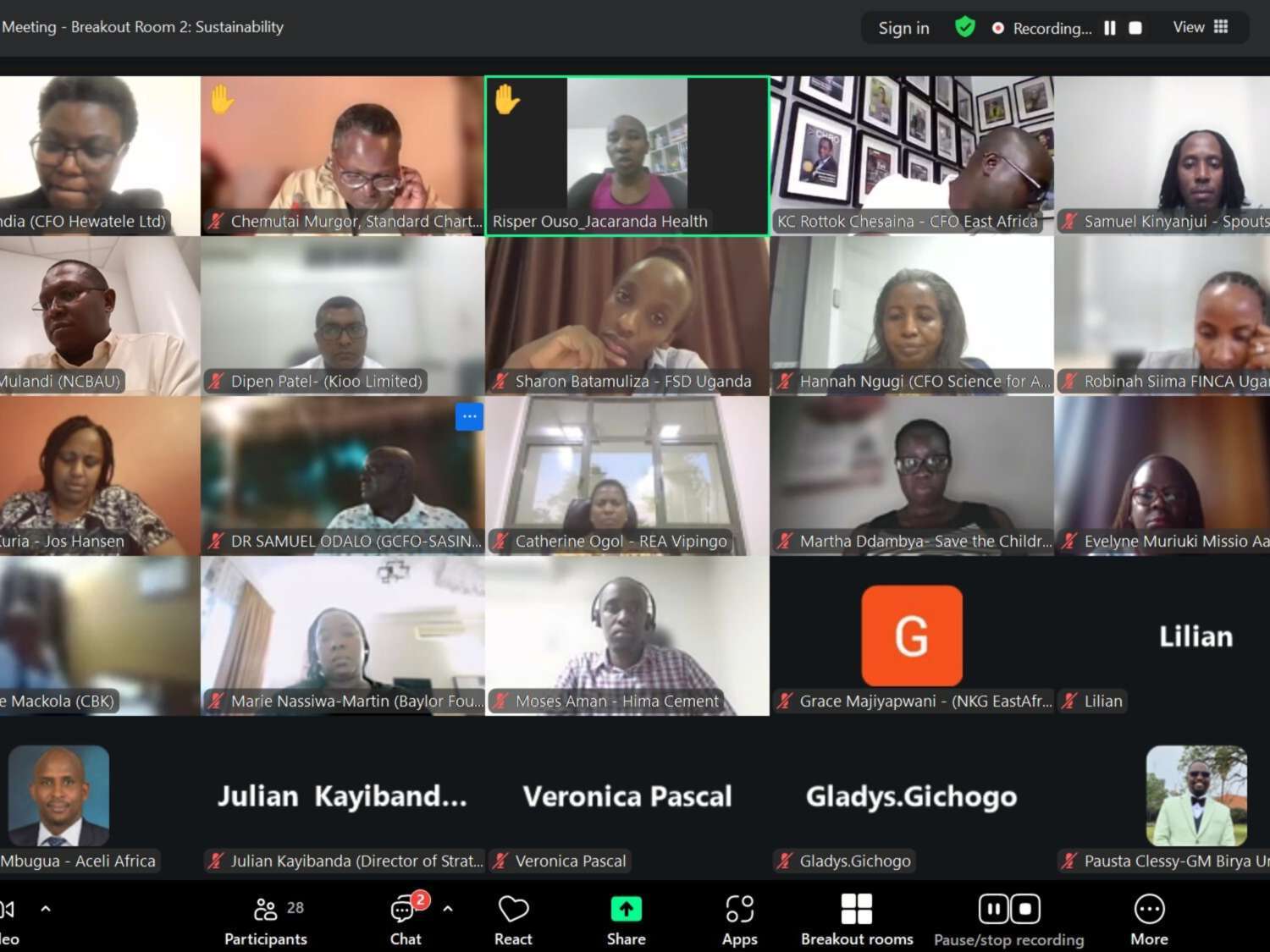
Following presentations from various industry leaders, CFOs engaged in a frank discussion during a breakout session that revealed that the modern CFO is becoming the chief architect of an organisation’s sustainability and resilience.
The conversation, anchored in the realities of the East African business landscape, highlighted how financial strategy must now encompass a holistic view of environmental, social and governance (ESG) factors, alongside a critical need for revenue diversification to ensure survival in an increasingly volatile global economy.
Executives agreed that the modern CFO is expected to be a change agent, shaping not just balance sheets but also the future direction of organisations.
“It’s not just about producing the numbers anymore,” one executive said. “The modern CFO must lead on resilience and sustainability, otherwise the business risks being left behind. That means asking difficult questions about whether the company is fit for the next decade, whether it can withstand external shocks and whether its growth comes with purpose. We cannot confine ourselves to reporting results, we must design business models that balance long-term sustainability with short-term performance.”
The discussion revealed how ESG is no longer an optional add-on or a branding exercise, but a fundamental part of financial strategy, shaping how capital is allocated, how risks are managed and how organisations define success in a rapidly changing world.
Environmental responsibility
“ESG is no longer just a buzzword. It has become part of the daily work of finance leaders, and when it is driven from the finance office, it moves beyond compliance and becomes part of strategy and culture,” one CFO said.
Executives stressed that because finance chiefs sit at the crossroads of capital allocation, risk and strategy, they are uniquely placed to embed ESG in decision-making. That vantage point, they argued, comes with responsibility.
Several participants spoke at length about environmental responsibility and the barriers that remain.
“Regulations that are well-intentioned sometimes make it harder to innovate. Something as simple as recycling becomes a struggle when the law classifies materials in a way that slows progress. The ambition is good, but the effect is an obstacle. What we need is stable energy, clear policy and financing frameworks that support sustainability rather than frustrate it. Without that ecosystem, green growth remains out of reach,” one finance leader highlighted.
Others offered examples of progress and commitment. They agreed it is not about branding but responsibility.
“Even in sectors that are not heavy polluters, the responsibility to act is the same. We have to build sustainability into the way we work, not treat it as a side project,” another CFO noted.
Creating opportunity
The conversation also focused on the social side of ESG, with many noting that finance leadership now includes shaping equity and wellbeing. One participant described the transformation within their organisation saying that finance leadership is not only about managing capital, it is also about creating opportunity.
“In a few years, we moved senior management representation from around 10 percent to about 45 percent. That was not an accident, it was deliberate. When you take diversity and inclusion seriously, it changes the culture of the whole organisation. People feel seen and they know the leadership reflects them.”
Participants agreed that socially conscious strategies strengthen trust and culture, while also helping to attract and retain talent in a competitive labour market.
A major point of contention and concern for several attendees was the financial sustainability of non-governmental organisations (NGOs). A CFO, reflecting on the experience of many in the sector, referred to the issue as a “concentration risk”.
In response to this vulnerability, a number of innovative solutions were proposed.
“The NGOs are really struggling with the aspect of compliance, taxation and issues around registration,” one CFO said, suggesting that a lack of legal clarity was a key barrier to diversification. Another panellist, a CFO with extensive experience in the NGO sector, advised that organisations should develop a “strong cost recovery policy”, ensuring that grants cover the full cost of service delivery.
The discussion also touched on the role of government, with calls for more collaboration and clarity. One CFO underscored the need for the government to provide a supportive policy environment, similar to the one that has propelled the growth of mobile money across the continent.
On governance, the mood was more confident. One executive noted that governance is something they have practised for a long time. Noting that their systems of transparency, compliance and accountability are strong.
Building resilience
“The challenge now is to take those principles and apply them to new risks, things like artificial intelligence, things like cyber security. The foundation is already in place and that gives us a platform to adapt,” one guest said.
Rather than treating governance as a hurdle, CFOs described it as the anchor that could support ESG transformation more broadly.
The conversation took a sobering turn when the issue of financial resilience was raised, particularly for organisations heavily dependent on external funding. Several participants warned of “concentration risk”, the danger of relying too heavily on a single source of income.
“We are not a project, so we cannot close. But when funding slows down, we have to make very hard decisions. That is the painful truth. The numbers do not always allow us to act with our hearts and for those of us in this position, that is the hardest part of the job,” an attendee said.
Others shared practical steps they had taken to build resilience. One CFO explained that they developed a strong cost recovery policy. Where every source of funding must cover the full cost of delivery, including overheads.
“The surplus goes into a reserve. It is not perfect, but it gives us breathing space when income shrinks. To a certain extent it has worked, and it proves that resilience must be built systematically, not left to chance,” the executive said.
While enthusiasm for ESG was strong, participants acknowledged that measuring progress remains a major hurdle. One finance leader said that they cannot improve what they do not measure.
Another stressed the importance of benchmarking. “You need to start with a baseline. Then you compare with peers, you share knowledge and you set your own targets. That is how you make progress. It is not about perfection on day one, it is about clarity, transparency and commitment.”
The discussion closed with a powerful reminder that the role of the CFO has permanently changed. The CFO noted that they need to stop thinking like a department head and instead they must ask themselves what problems they are solving across the organisation.
“Is it a cash flow problem, or is it a business model problem? That is where the modern CFO must live. Resilience today means knowing when to invest, when to innovate and when to lead the conversation. That is what will separate tomorrow’s winners from those who fade away,” the CFO noted.