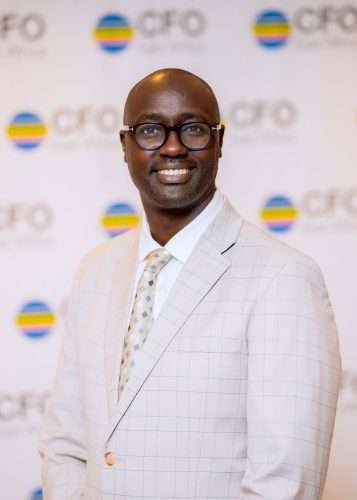
At the 2024 CFO East Africa Year-End Summit, Bayport Tanzania CFO Rehema Sanare, acting MTN Rwanda CFO Dunstan Stober, Rocket Health Uganda CFO Fiona Nuwamanya, and Mitchell Cotts Kenya finance and strategy director Michael Nzule shared their highs and lows for the year and discussed the opportunities and risks of digital disruption
Emerging digital technologies have drastically changed the business landscape, creating new challenges and possibilities for organisations. According to Rehema, Bayport Tanzania has seized these opportunities by transitioning to a fully paperless system. The lender, which previously had 96 branches across Tanzania and a sales agent force of 3 000, now operates digitally with a staff of 68. Bayport also uses voice recognition technology to authenticate identity.
“In terms of our niche market and Tanzania as a whole, we are way ahead of the game. We are the only business doing voice contracting. Everyone else is now catching up,” she said.
Rehema revealed that fintech was part of the company’s long-term vision and is embedded in every facet of the business. She views the integration of emerging technologies as an industrywide imperative, and not the sole preserve of large corporations.
“There was a time when a story broke at midnight in Tanzania, and a big newspaper did not carry it, but people already knew because of online media. Digital disruption has brought in significant revenue growth. When you have the muscle to invest, you are ahead of the curve. The boom in transactional business from digital products has brought growth. It has also transformed the customer experience,” she said.
The move has also had an impact on Bayport’s ESG strategy. As the firm moves away from paper, its emissions reduce.
Her sentiments were shared by Michael, who noted that digital transformation was key to remaining competitive in the logistics industry. He revealed that the shift had revolutionised the business and raised customer expectations, necessitating changes such as warehouse automation and the integration of AI to predict routes.
“Disruption is driven by not just providers, but also consumers. Customers will order anything on digital platforms. It is up to players in the digital space to simulate demand patterns,” he said.
For MTN Rwanda, fintech has opened up new markets. Dunstan noted that the company has witnessed significant growth through its mobile money offerings, which have also had an impact on communities.
“MTN Rwanda has set the standard for fintech in the MTN group. Over 70 percent of our customers use mobile money. Our agent network has exploded. It is mindblowing,” he said.
On the flipside, digital disruption has brought with it novel risks. A new report from the 2025 PWC East Africa Digital Trust Insights (DTI) Survey shows three in every four organisations operating in East Africa have identified cyber-risks as their top concern. The question was also raised by Rocket Health Uganda’s Fiona, who sought to know how businesses can improve cybersecurity and tackle operational challenges. The company is in the midst of a merger aimed at consolidating its position.
“We are seeing lots of advancement in new diagnostic tools. Many want to partner with us to integrate their systems with ours. I downloaded the M-Pesa app recently, and I was shocked at the number of integrations. But our economies are not the same. Internet penetration in Uganda is at 13 million, which is low. It is not good for business. If I am pursuing a digital strategy, is it forward-looking, and does it bring in money?” she said.
The panelists also lamented that regulation had lagged behind the pace of digital technology, creating grey areas that brought in uncertainty. This emerged as a common challenge across the region. While acknowledging the recent regulatory hurdles Elon Musk’s Starlink has faced in Zimbabwe, South Africa, Botswana, Cameroon, and Namibia, Dunstan saw digital disruption as a net positive to the telco industry.
“Today, your sim card can fit on the tip of your finger. Innovations are giving us the opportunity to design products that delight customers. It has transformed the business and made it more efficient. Before I went to the airport last night, I found myself talking to the car. But on the flipside, the more digitalised you become, the more risk you face. One hit can shut you down. In 2025, the focus will be on how to evolve from a telco that does voice and data to a tech company,” he said.
To address the risks on a strategic level, Rehema proposed the inclusion of ICT personnel in executive communities for greater impact. She also urged companies to invest in their teams and customise digital solutions for their businesses.
“Before you acquire any digital product, you must go through approval to know what you intend to achieve. Is it a product, a process or is it for convenience? What are the loopholes? Do not buy something off the shelf because another company did it, the technology must serve your organisation's particular purpose” she said.