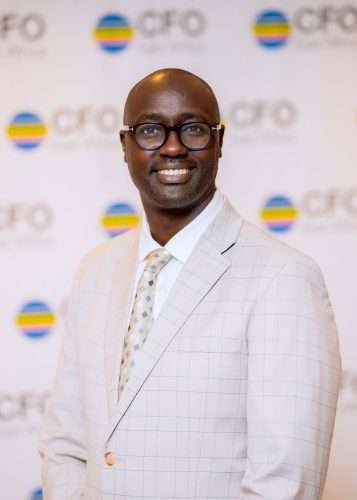
AI is moving beyond chatbots and prompts, with new systems capable of carrying out tasks with limited human intervention. At CFO East Africa’s CFO of the Future Summit in Dar es Salaam, Dr Allen Mutono challenged finance leaders to rethink how they use AI while keeping human judgement at the centre.
For finance leaders, the biggest question about AI may be how to use it without handing over the judgement and expertise that make the finance function valuable.
This was the challenge Dr Allen Mutono, CEO of the IALE Institute and author of The AI Toolkit, brought to the CFO of the Future Summit in Dar es Salaam. His keynote moved beyond the familiar conversation about chatbots and productivity to examine what happens when AI begins taking on entire tasks.
“AI is a topic that we find exciting and confusing in equal measure. We have this thing going around. We know about it, we actually use it, but we may not fully understand it,” he said.
As Allen sees it, that uncertainty matters because the technology is moving quickly. He traced his own experience with AI back to 2015, when he encountered a neural network at work, before turning to the latest shift from systems that respond to prompts to systems that can pursue an assigned goal.
“On the one hand, we have AI that is shifting from prompting to agentic frameworks. In other words, we are transitioning into an area whereby you set up, you assign it, and by itself it will complete the goal you assign it and give you a result,” he explained.

Autonomous agents
For CFOs, that shift comes at a particularly important moment. Their responsibilities are already stretching beyond financial reporting into risk management and compliance, while sustainability reporting is adding new demands around data and accountability.
“As finance people, everyone expects you to be looking at the money, to be thinking about money, or to be counting money, only to hear you becoming data analysts, hearing you managing risk, collecting data, doing your compliance. Think about where this puts you,” he went on.
The answer, Allen argued, cannot be to adopt every new AI system simply because it promises greater efficiency. He warned that the rush to experiment is already creating a parallel problem inside organisations, with employees using private AI tools to process company information without proper controls.
“We have the problem of shadow AI, where people are unable to access the current models or do not have processes at work whereby training has been done. They are putting their information from work into their private AI modules and turning it into work slop. But so much has compromised the integrity of the organisation, IP, and as well as confidential data being available to the public,” he said.
Allen then brought the discussion back to something particularly relevant for finance leaders. As AI becomes more powerful, the consequences of getting its output wrong do not disappear simply because a machine produced the answer.

Navigating risk and responsibility
“At what point do we allow AI agents or AI processes to inform our decisions, to inform our processes? Sometimes things go wrong, and responsibilities apportioned, the agent can never be in court. It’s you that will be in court, so we can’t get it wrong,” he said.
His answer was to become more deliberate about where it sits within the organisation. He argued that businesses need to look beyond the chatbot model towards secure, purpose-built systems that can work with the context and data of the organisation.
“It emerges not just as a tool, but as another factor of production, which is forming a layer of intelligence beyond the traditional factor of production, capital, labour, and now you have intelligence and production,” he explained.
Instead of thinking about jobs as fixed units, Allen urged leaders to break work down into individual tasks and decide which should remain with people, which machines can handle and which are best done collaboratively.
“AI has allowed us to look at work as a collection of tasks, not as a specific job. That requires a multidisciplinary approach,” he said.

A new factor of production
For finance teams, that could mean handing routine number crunching and mundane work to machines while using the time gained for strategy and leadership. But Allen’s final point was that the transition cannot happen at the expense of the people doing the work.
“Once you can put number crunching and the mundane tasks in bucket two, which are done by the machine, then you can allocate the extra time you get to delivering on a vision or a strategy for your organisation. But most importantly, take your teams along with you.”
This, he said, is where the human advantage remains. He closed on five capabilities he believes machines cannot replicate, putting the emphasis back on the qualities finance leaders will need most as AI becomes more deeply embedded in their work.
“There are five competencies that only humans can have, which is courage, creativity, curiosity, communication, and compassion, which machine cannot have,” he said.