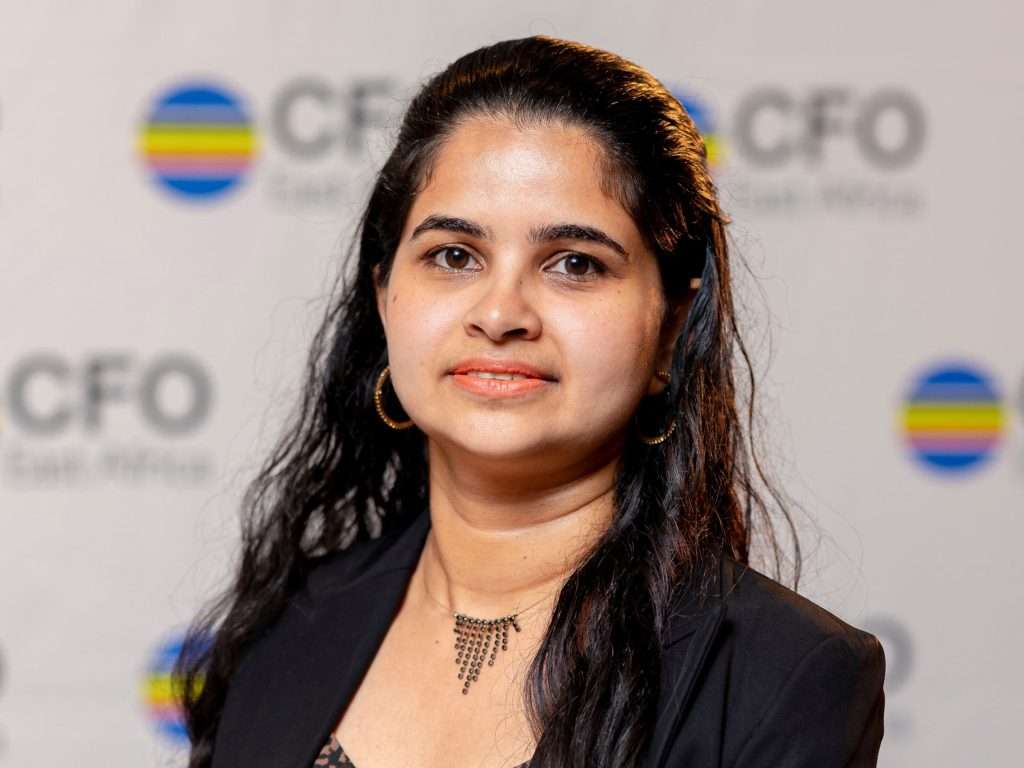
2026 CFO Awards judge Shereena Wilson, a software developer turned finance leader, unpacks the critical intersection of AI, blockchain and ESG.
The Fintech Forensics founder explains why treating finance as a systems design problem is the true differentiator for success in an era of rapid automation.
You started your career as a software developer and IT specialist before moving into finance. How do you think that foundation of IT shaped the kind of finance leader that you became?
My technology background helped me stand out from other finance professionals, who often take a step back and call IT to fix things. I never worked as a purely traditional CFO; I was always heading IT and digital transformation, focusing on people, processes, and systems. That engineering mindset means I naturally treat finance as a systems design problem – when numbers break, the root cause is almost always in the process or the system, not the spreadsheet.
I see that you use things like AI for fraud detection and forensic auditing and even a bit of ESG. What gap in the market were you solving for and what has building this practice taught you about where finance is heading?
The biggest gap is that we still train finance professionals in silos, teaching compliance but failing to train them as commercial operators or systems architects. Aspiring CFOs must step out of the finance department, seek cross-functional roles, understand the technology stack, and translate financial reporting into a commercial narrative. When you integrate AI analytics with forensic auditing and blockchain governance into a single workflow, you can detect anomalies in real time and trace transactions end to end, and that is the kind of capability gap the market still needs to close.
From your experience, what does a fractional engagement done well look like in practice and where does it often go wrong? A successful engagement looks at the company holistically including operations, HR, marketing etc. You must have deep conversations with the founder/CEO and/or the team to understand their systems, processes, and how people communicate. I prioritise connecting siloed systems to bring a true, real-time picture of the company to its leaders. In practice, the first step is usually a technology assessment, evaluating the ERP, reporting tools, and data flows. Once those systems are integrated and routine reporting is automated, leadership gains the visibility needed to focus on strategy.
What prompted you to become a judge for the awards? What do you hope to contribute to the process?
I joined the panel because I want to see exactly where East Africa stands right now. I am highly invested in evaluating how well our CFOs integrate technology compared to global benchmarks, spotlighting the leaders driving this evolution. Working across sectors like renewable energy, healthcare, and fintech has shown me how the right technology infrastructure can fundamentally reshape a finance function, and I want to see whether that shift is taking hold in this region.
You sit at the intersection of AI and blockchain and forensic accounting and ESG. These are areas most CFOs are trying to navigate separately. How should finance leaders be thinking about these things as a connected strategic agenda rather than separate things?
The defining shift is that a modern CFO cannot be functionally illiterate in technology. Successful CFOs will act as integrated business operators who embrace technology to build AI-driven infrastructure that eliminates departmental silos. We should no longer just report numbers; we must engineer the systems that generate them in real time. AI tools are evolving fast, outperforming experienced CFOs in analysis and building complex models in minutes. These technologies reinforce each other: AI surfaces patterns, blockchain provides the audit trail, forensic tools verify integrity, and ESG frameworks set direction.
What gaps do you see in how we’re developing finance professionals in Africa? What should aspiring CFOs be investing in beyond just those paper qualifications?
Even when the CFA curriculum now include mandatory practical modules on data science and automated financial modelling, people often treat them as a mere box-ticking exercise. Holding a CPA or CFA alone will not be sufficient in the next five to 10 years. Finance is among the next major functions to be significantly impacted by automation. Skills like ERP implementation, automated reporting workflows, and AI-driven forecasting are no longer IT competencies, they are core finance skills.
When you will be evaluating candidates for the awards, what distinguishing qualities and competencies will you be looking for?
I will specifically look for executives who have moved beyond surface-level digitisation to deep technology integration. Exceptional CFOs actively redesign workflows to leverage predictive analytics and automation rather than just buying off-the-shelf software. Alongside tech acumen, I look for the ability to translate complex systems data into clear, actionable commercial insight. The true differentiator is a leader who acts as a strategic architect, building resilient governance frameworks that allow secure scaling while inspiring their teams to embrace technology.