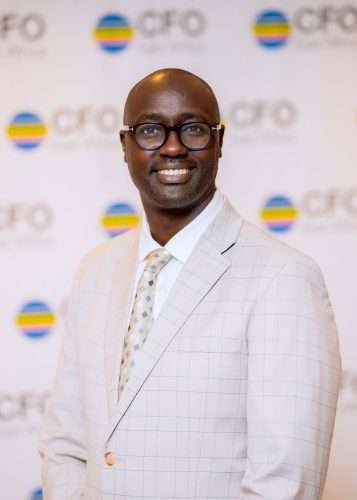
WPP Scangroup CFO Sanjeev Panwar, I&M Bank Rwanda CFO Dederi Wimana and Rwanda Fertiliser Company CFO Patrick Marara make the case for people skills as the most essential tool in a finance leader’s arsenal.
Sanjeev Panwar has spent nearly two decades at WPP Scangroup, rising from finance manager to CFO. Early in his career, he was drawn to the power of financial decision-making, the way choices made in a room could ripple out and affect people’s lives months or years later. But the longer he has led, the more convinced he has become that technical skill alone cannot carry a finance leader.
“Beyond finance, I have observed that leaders who lead well are there with empathy and clarity. If you’re not clear, you can’t lead your team. Technical skills are important but that alone is not enough in this complex environment. And you’re dealing with people, not machines. They have their own emotions. Whenever you say something, different people take it differently. So, you have to tackle all of that,” he says.
For Sanjeev, developing people skills has also meant learning when to slow down. He describes pressure as something that narrows thinking and has made a deliberate practice of creating space for reflection, whether through a mentoring conversation or simply stepping away for a moment. The ideas that come in those pauses tend to be better.
“I learned to make space to slow down because sometimes quiet reflection or a mentoring conversation gives you perspective. If you get some space to slow down, you will find more ideas, out-of-the-box ideas, and you will do better. Leadership is a journey, not a destination. You will learn something on every step,” he explains.
Lessons fron unlikely places
Dederi Wimana describes herself as someone who used to be tough. As CFO of I&M Bank Rwanda, she leads with what she calls collaboration and open-mindedness, but she is candid about the fact that this did not come naturally. The shift began at home. With four children between the ages of 16 and 26, all of them Gen Z, she found herself in recurring conflict with her eldest two after they returned from university.
“When the third one, a boy, was close to me and we also started fighting, I said I must be the problem. So I looked at myself and I said I have to change. That helped me even with the team I have currently. The way I see these Gen Zs, they have to feel participative. You have to involve them in everything, not come and say I want this and this. Now I ask them what they think, and we are aligned,” she says.
She currently mentors five senior managers through a structured two-year programme with monthly check-ins and defined goals. Several of her former reports have gone on to become CFOs and chief internal auditors at other institutions. She counts them among her proudest professional achievements.
“I share what I know and give them the opportunity to do it. Good talents are becoming rare and they are costly because competition is big now. I prefer someone at a middle level with potential rather than waiting for the most experienced person. You invest in them, you see them grow, and then one day you see them leading their own teams somewhere else. When I see those people, I feel proud,” she says.
The diplomat in the room
Patrick Marara Shyaka came to the private sector from a long and senior career in Rwanda’s public finance system, including a term as accountant general. In his early months, he was so focused on standards and financial processes that he failed to read the culture around him.
“Whatever the case, what I’ve learned now is that when you change from one institution to another, it’s not about the technical aspect. The biggest aspect is the people aspect. How you adapt to people and how you bring them close to you so that you can understand the environment you are in. I missed that so much, and it caused a conflict of miscommunication and misunderstanding,” he says.
The skill Patrick has come to prize most is diplomacy, which he describes as the art of saying no without becoming the bad guy. In his experience, the CFO is often the person who must deliver unwelcome news. How that message lands depends almost entirely on how it is delivered.
“You have to go slowly. Otherwise, you might kill the mood of doing business. You say, okay, good idea, but perhaps this year we are a bit tight. How about we think of putting it in next year’s budget? You are refusing, but in a diplomatic way, giving alternatives. People should feel like you are open-minded. You should be the first one they want to consult, not the last,” he says.