Hundreds of leading CFOs from Kenya, Rwanda, Tanzania and Uganda gathered online for CFO East Africa’s first Virtual Summit, titled CFO Ideas Worth Sharing.
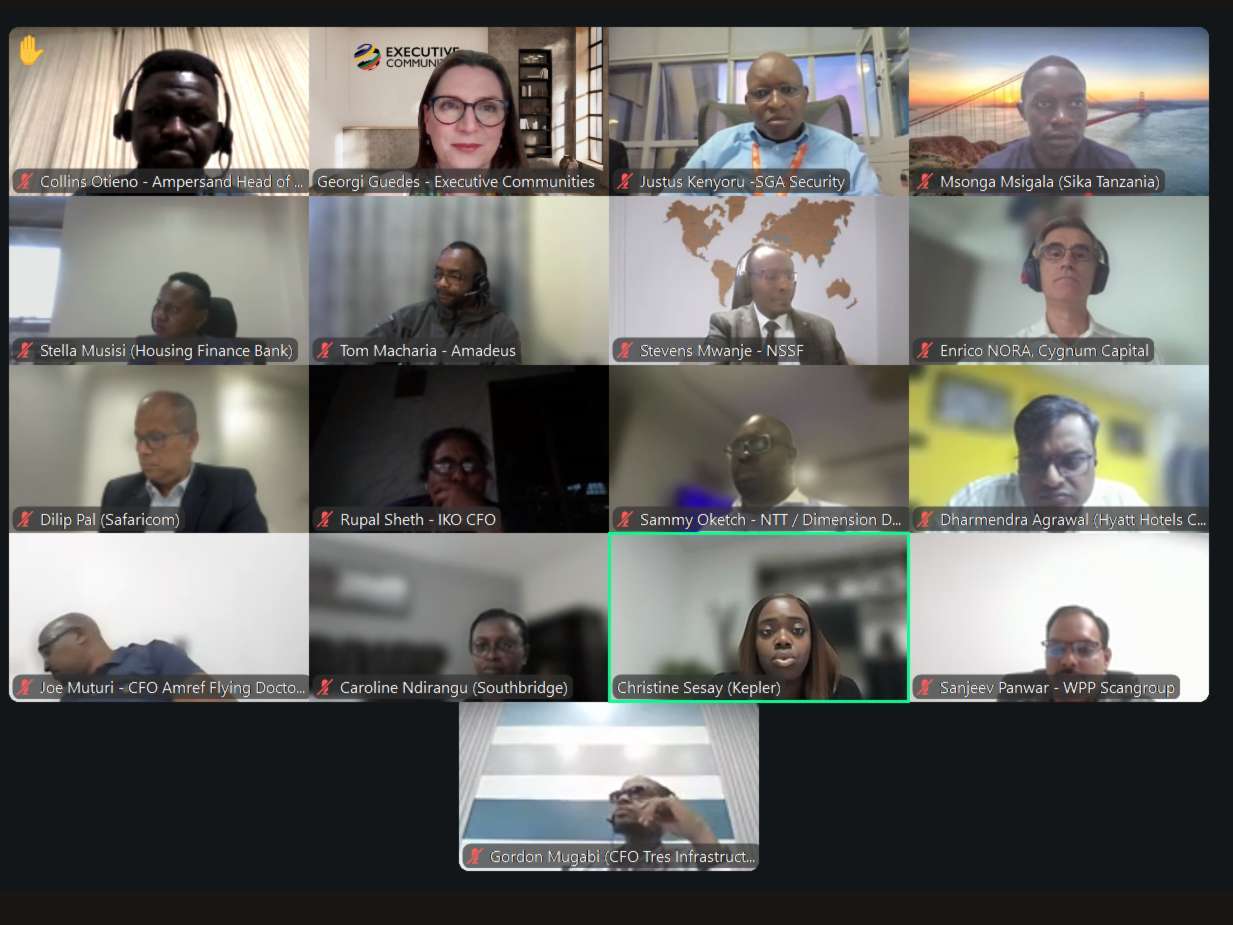
Following thought-provoking presentations from CFOs across a number of industries in the region, participants had the opportunity to split into interactive breakout discussions that allowed for connection, engagement and the sharing of memorable best practices.
Kepler CFO Christine Sesay, Safaricom CFO Dilip Pal and NSSF Uganda CFO Stevens Mwanje were the lead participants in the breakaway session themed, Let’s talk leadership.
The discussions went to the heart of modern financial leadership, reflecting on the nexus between personal and professional purpose, the role of CFOs in strategy and the involvement of CFOs in the growth path of leading companies.
The majority of attendees believed effective leadership goes beyond managing finances and requires a clear personal mission.
Christine recounted a personal example of advocating for financial literacy for students.
“We’ve got students who want to take out bank loans and we need to ensure that they make the right decision at such a young age. They may not understand that their credit may be affected. The personal financial management piece is what I have picked up, in addition to the daily running around that a CFO has to do,” she explained.
Building for the future
Dilip, speaking on Safaricom's expansion into Ethiopia, described his approach to leadership as being guided by a long-term vision.
“It was not difficult for me to articulate the thought of transforming lives. What we are building is not for the next three months or a few years, it is for the future. No matter whether the road is bumpy or not, it is a clear path,” he said.
“You believe in the cause and get some movement,” he added.
Stevens noted that a CFO is involved in every major decision.
“As a CFO, there’s no neutral decisions, with business decisions either you have to raise revenue or lower costs, so you have to be involved. This cuts across revenue, strategy and operations, where the CFO has to be involved. The CFO is the epi-centre of everything. You should be at the forefront,” he stated.
An attendee picked up on this thread of thinking, adding that it is “Important to be consistent when there are tough decisions”.
“The vision is still there but doesn’t mean every step is going to be easy,” he said.
Meanwhile, an attendee in the development sector shared his fortunate experience of “being lucky to have found a nexus between career and personal purpose”.
“I find it very fulfilling as a person and have found a space in my career where there is a connection,” the attendee said.
Sector-specific leadership
With CFOs in the breakaway representing the cross-section of private, public and development sectors, lively discussion was had whether the CFO role is one of leading or following.
An attendee noted the difference between working as finance chief in the public sector and versus the private sector.
“The private sector [CFOs] are more involved because there is the numbers and data to make informed decisions for investments. In public service, it’s about providing services for the citizens,” the attendee explained.
“In the public service, whether the CFO is involved in strategy or not, that CFO is there to allocate budgets. We are there to understand the strategy to be able to co-ordinate in the implementation and execution of the department or ministry – and ensure it is reflected in the appropriate budget. There is a tendency to perceive the public services CFO as not having the full knowledge of the core mandate of the institution,” the attendee revealed.
"CFOs are there to do much with less resources. We have to make ends meet with what we have and what we have to achieve," the attendee added.
A predominant view from the private sector was the need for the CFO to be the driver of strategy.
“We find in leading finance functions that there is also a dotted line to Legal, HR and even Facilities. So, you still have to provide leadership to functional leaders and guidance to higher up decision makers. You need to provide leadership and be recognised as the go-to person who will push back. It takes some risk and you have to be able to make a decision,” an attendee said.
“At the same time, you are not by yourself. This is why you have to always provide leadership to the team and upskill and develop those who come after us,” the attendee added.
As the breakaway session drew to a close, all attendees appreciated the joke that was shared by an attendee: “If the company does well, the credit goes to the CEO. If the company doesn’t do well, the CFO has to answer.”